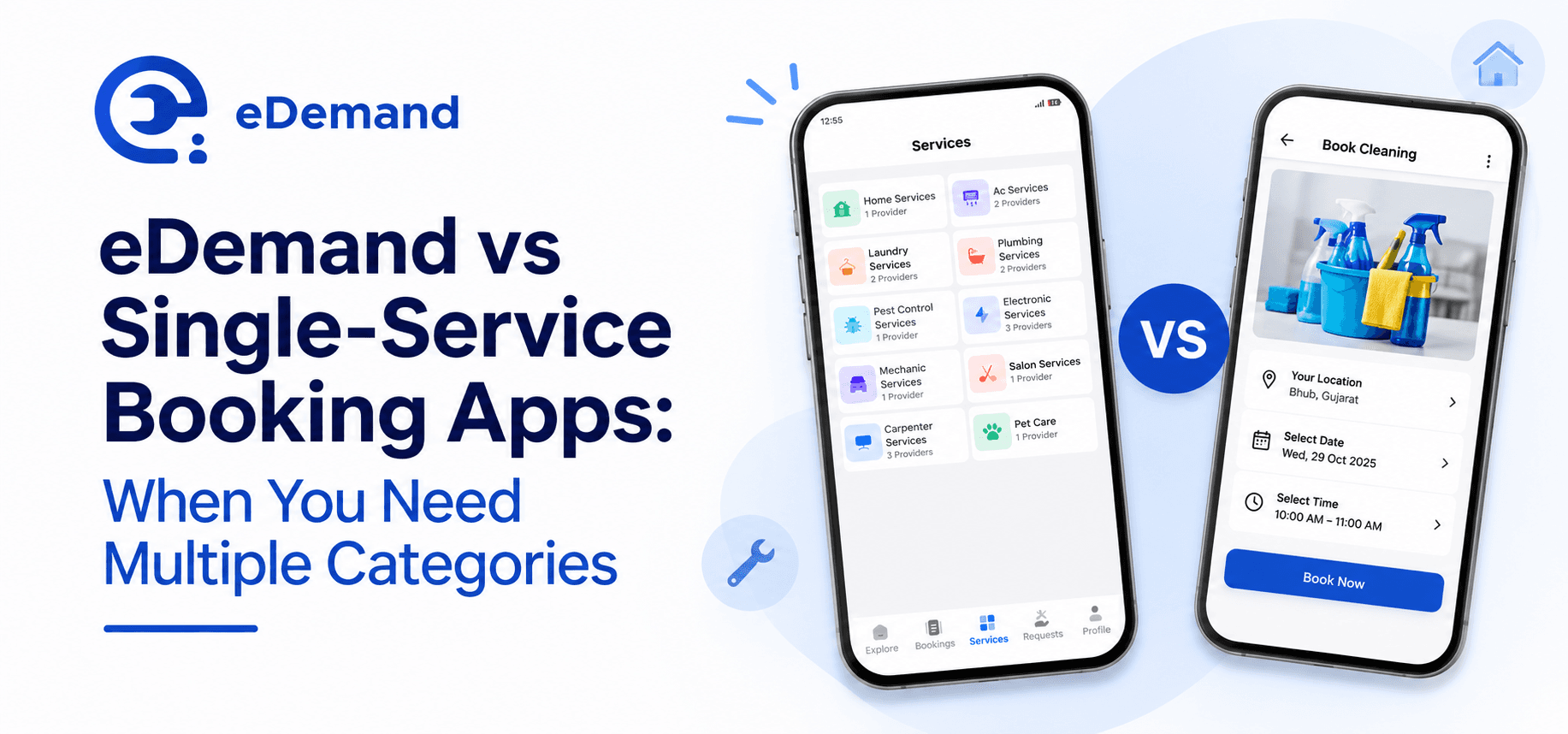
Most service businesses begin with one idea. A cleaner, a plumber or an electrician sees demand, builds a simple booking app and starts taking orders. That works well at first. The question arises when customers start asking for more: "Can I also book a painter?" or "Do you offer appliance repair?" At that point, the owner of a single-service booking app has to decide whether to stretch the app, build a second one or move to a platform made for several categories. A multi-category on demand handyman app such as eDemand is built for that third choice.
This post compares eDemand with single-service booking apps. You will see where each model works, where each one struggles and how to judge which one fits your plans.
1. Two Models Compared
Before looking at details, it helps to define what each model is.
The Single-Service Booking App
A single-service app is designed around one type of work. It might handle only home cleaning, only car washing or only plumbing. Its screens, pricing rules and provider tools are all shaped around that one service. It is usually simple, focused and quick to understand.
The Multi-Category Platform
A multi-category platform lets several types of services live in one marketplace. Customers see one app with many categories, and providers offer the services they specialize in. eDemand is a multi-vendor on-demand handyman and home service platform, with a Flutter customer app, a Flutter provider app, a Next.js website and a CodeIgniter 4 backend.
The Real Question
The choice is not about which model is better in general. It is about how many services you plan to offer now, how many you may add later and how much extra work each new category creates.
2. Why Single-Service Apps Are So Popular
Single-service apps are popular for good reasons, and it is only fair to say so.
Simplicity
One service means one clear flow. Customers know exactly what the app does, and owners know exactly what to manage. There is less to configure and less to explain.
A Clear Starting Point
Founders often search for a handyman app like Uber because they want the same simple experience of finding a nearby professional and booking a time. A focused app delivers that experience for one kind of job without extra complexity. This is not a claim that any product matches another brand's features, only a description of what buyers are looking for.
Faster Early Focus
With one service, you can focus all your marketing on a single audience. You learn what customers want, refine your pricing and build a reputation before expanding.
3. Where Single-Service Apps Hit Limits
The trouble begins when the business grows beyond its first service.
New Categories Mean New Apps
If you want to add a second service, a single-service app may not allow it. You may need a second app, a second admin panel and a second set of providers. Each additional category multiplies the work.
Split Customer Bases
Customers who book a cleaner in one app and a plumber in another become two separate customers in two separate systems. You lose the chance to cross-sell, and customers must install and learn several apps.
Duplicated Admin Work
Each app has its own provider approvals, its own payment records and its own reports. Combining them into one picture means exporting data and merging it by hand.
Higher Marketing Cost
Promoting several apps separately costs more than promoting one brand with many services. Each app needs its own downloads, reviews and visibility.
4. Side-by-Side Comparison
The table below summarizes how the two models differ on the points that matter most.
|
Area |
Single-Service Booking App |
eDemand |
|
Service range |
One type of service |
Multiple service categories in one marketplace |
|
Adding a category |
Often needs a new app or major changes |
Managed within the same platform |
|
Customer experience |
One app per service |
One app and one account for many services |
|
Providers |
Specialists in one trade |
Providers across many trades |
|
Admin panel |
One per app |
One panel for the whole marketplace |
|
Booking flow |
Built for one service |
Supports multiple services from one provider in one order |
|
Custom jobs |
Rarely supported |
Customers can post custom jobs and receive bids |
|
Revenue options |
Varies by app |
Commission, subscriptions, a hybrid model and ads |
|
Marketing |
Separate effort per app |
One brand across all categories |
|
Best for |
A single focused service |
A growing or broad service business |
Features of single-service apps vary from product to product, so check any app you consider against your own requirements.
5. The Customer Experience Compared
Customers care about convenience, and the difference shows quickly.
One App for Many Needs
Homeowners rarely need only one service. Over a year, they may need cleaning, plumbing, electrical work and repairs. A platform that covers all of these in one app brings them back instead of sending them to other apps.
Booking Several Services at Once
In eDemand, customers can add several services from the same provider into a single order. For example, someone can book a tap repair and a light fitting replacement in one visit. This saves time for the customer and raises order value for the provider.
Help for Unusual Jobs
Not every request fits a standard listing. eDemand lets customers post a custom job with a description and photos, and providers respond with bids. A fixed single-service app usually has no way to handle jobs that fall outside its menu.
Finding Nearby Help
Nearby providers appear through Google Maps-based geolocation, so customers see who is close without choosing from long lists. This works across every category on the platform.
6. The Provider Experience Compared
A marketplace grows when providers are happy.
Provider-Driven Management
In eDemand, providers manage their own services, pricing, profiles and working hours. They do not wait for an admin to update a listing, and the admin team does not carry the daily workload. This model works the same way whether you have ten providers or many more.
More Ways to Earn
A provider who offers several services can earn from all of them on one platform. Timeslot suggestions based on availability reduce scheduling conflicts, so providers spend less time confirming appointments.
Specialists in Different Trades
A multi-category platform also lets you onboard different trades side by side. A plumber, an electrician and a cleaner can each build their own profile and reputation in the same marketplace.
7. Admin and Operations Compared
The daily workload of the owner often decides whether a business stays manageable.
One Panel Instead of Several
With a single-service approach repeated across categories, the owner manages several panels. With eDemand, one admin panel covers providers, bookings and settings across every category.
Less Manual Setup
Because providers appear through geolocation, you do not need to set up countries, states or cities by hand. This reduces the ongoing effort of managing service areas as you grow.
A Clear View of the Whole Business
Reports in one place show which categories grow fastest and which providers perform best. Owners can then decide where to focus marketing and recruitment.
8. Revenue Compared
Earning potential grows when categories share a platform.
Revenue Models in eDemand
eDemand supports several income paths:
-
Commission on every completed booking
-
Monthly or yearly provider subscriptions
-
A hybrid model that combines both
-
AdMob and AdSense ads inside the customer and provider apps
Why Categories Help
More categories mean more bookings from the same customers, and more providers mean more commission and subscription income. You can also adjust the revenue model as your marketplace matures, without rebuilding anything.
Single-Service Revenue
A single-service app can earn well within its niche, but its income is limited by that one service. Growth often depends on adding new apps, which brings the extra costs described earlier.
9. Cost and Build Effort Compared
Price is only part of the picture, but it deserves a close look.
The License Price
At the time of writing, the eDemand Regular License is listed at $39 and the Extended License at $799. Both are one-time licenses with lifetime validity and free updates. The Extended License adds a ready-to-launch configuration for Android, iOS, Web and Admin Panel, with six months of dedicated support.
Building Your Own
Many founders who search for Uber for handyman app development are weighing a custom build against a ready-made base. A custom multi-category platform needs customer and provider apps, a website, an admin panel, scheduling logic, payment flows and commission tools. Building all of that usually takes months and a significant budget.
Planning the Technical Scope
If you are scoping on-demand handyman app development, list the parts you would need: apps for customers and providers, a backend, payment gateways, SMS gateways and notifications. eDemand uses Flutter for the apps, Next.js for the website, CodeIgniter 4 with MySQL for the backend and Firebase services for notifications, so these parts already work together.
Costs That Apply Either Way
Hosting, payment gateway fees, SMS charges and Firebase usage apply to both approaches, so include them in your plan.
10. When a Single-Service App Is Enough
An honest comparison also says when not to choose a multi-category platform.
Good Reasons to Stay Focused
A single-service app may be the right choice if:
-
You offer only one service and have no plans to add others
-
Your business depends on a very specialized workflow
-
You want the simplest possible product for a small local market
-
You plan to test one idea before committing to a bigger platform
Signs You Need Multiple Categories
Consider a multi-category platform when:
-
Customers keep asking for other services
-
You want to onboard providers from different trades
-
You want one brand and one app for everything
-
You plan to earn from commissions across many service types
11. What eDemand Is Not
It is useful to be clear about scope.
A Service Booking Marketplace, Not a Super App
Some buyers search for a Gojek clone script because they want one app that covers transport, food, payments and services. eDemand is not a copy of any brand and is not a super app. It is a purpose-built service booking marketplace for handyman and home services, with several categories under one brand.
What That Means for You
If your goal is a broad lifestyle super app, you will need a different scope. If your goal is a home services marketplace with many trades, eDemand covers that need directly.
12. A Simple Decision Checklist
Use this list to judge your own plans:
-
List the services you want to offer in the first year.
-
Note which services customers have already asked for.
-
Estimate the cost of a separate app for each service.
-
Decide how you want to earn from providers.
-
Choose the model that covers your list with the least duplicated work.
Where eDemand Fits
eDemand suits entrepreneurs, agencies and developers who want a ready-made home services marketplace with provider tools, scheduling, bidding and flexible revenue models already in place. It lets you start with one or two categories and grow without rebuilding your system.
See Which Model Fits Your Business
Ready to launch a home services marketplace with room to grow? Explore the features, demo and license options for eDemand on the WRTeam Marketplace.