Home service business owners usually start the same way. They search for how the big ride-hailing and delivery names run their apps, then try to picture that same setup for a handyman or home repair brand. Somewhere in that research, the plan quietly turns into a much bigger build than a home services business actually needs.
A home service booking platform does not need ride dispatch, food delivery routing, or a dozen unrelated verticals bolted onto one backend. It needs a small set of things done well: providers who can list and manage their own services, customers who can find help nearby, a clean booking flow, and a way to collect payment. eDemand is built around exactly that scope, and this post looks at why staying inside that scope is usually the faster, cheaper way to launch.
This matters most in the early stage of planning, before a single line of code is written or a single feature list is drawn up. That's the stage where founders often overcommit to a broader platform than the business needs, simply because the reference points they know best (large multi-service apps) happen to be built that way. Understanding what a handyman or home repair business actually requires, separate from what a delivery or ride-hailing app requires, changes the entire scope of the project before it starts.
Why Super-App Thinking Slows Down Home Service Launches
The idea of one app doing everything is appealing on paper. In practice, it adds cost and delay that a focused home service business rarely gets back.
A lot of that thinking starts with search behavior. Founders type handyman apps like Uber into a search bar because Uber's interface is the reference point everyone recognizes, not because they actually want ride-hailing features. What they usually mean is that they want a booking experience that feels as smooth and trustworthy as Uber's, applied to plumbers, electricians, cleaners, and repair technicians instead of drivers.
That distinction matters, because a true multi-vertical build carries costs a single-category platform never touches:
-
Separate booking logic for each service type it supports
-
Dispatch and routing systems built for movement, not for scheduled home visits
-
Extra admin panels and reporting for verticals that may never launch
-
A longer QA and testing cycle before anything goes live
-
Ongoing maintenance across code that has nothing to do with home services
None of this helps a handyman or home repair brand get bookings faster. It just adds months to a launch that could otherwise start with a script built for the job in front of it.
There is also a maintenance cost that gets overlooked at the planning stage. Every additional vertical a platform supports is another set of edge cases, another category of support tickets, and another piece of code that needs updating when payment gateways or mobile operating systems change their requirements. A single-category home services platform has a much smaller surface area to maintain, which matters once the business moves past launch and into daily operation with real providers and real customers depending on it working correctly.
What a Focused On-Demand Handyman Platform Actually Needs
Strip away the super-app assumption and the real requirements for a home services business are fairly short. Most entrepreneurs searching for on demand handyman app options are, whether they realize it or not, looking for a platform that covers:
-
Service listings providers control so onboarding a new plumber or cleaner does not require admin intervention every time
-
Location-based discovery so customers see providers who can actually reach them
-
A booking flow that handles scheduling, not just an inquiry form
-
Payment collection built into the app, rather than left to providers to arrange offline
-
A revenue model for the platform owner, whether that is commission, subscription, or both
Agencies fielding client requests for uber for handyman app development run into this same gap. Clients ask for an "Uber-style" build, but what they need scoped and quoted is a single-vertical home services platform, not a multi-service dispatch network. Framing the project around that shorter, more specific list keeps both the budget and the timeline realistic.
It also changes what a proposal or feature spec should look like. Instead of a document trying to account for ride matching, delivery routing, and food ordering alongside home services, the scope narrows to booking flow, provider tools, geolocation, and payments. That shorter list is easier to estimate accurately, easier to test thoroughly before launch, and easier to explain to a client or investor who wants to know exactly what they are paying for.
How eDemand Covers Home Service Bookings Without the Extra Weight
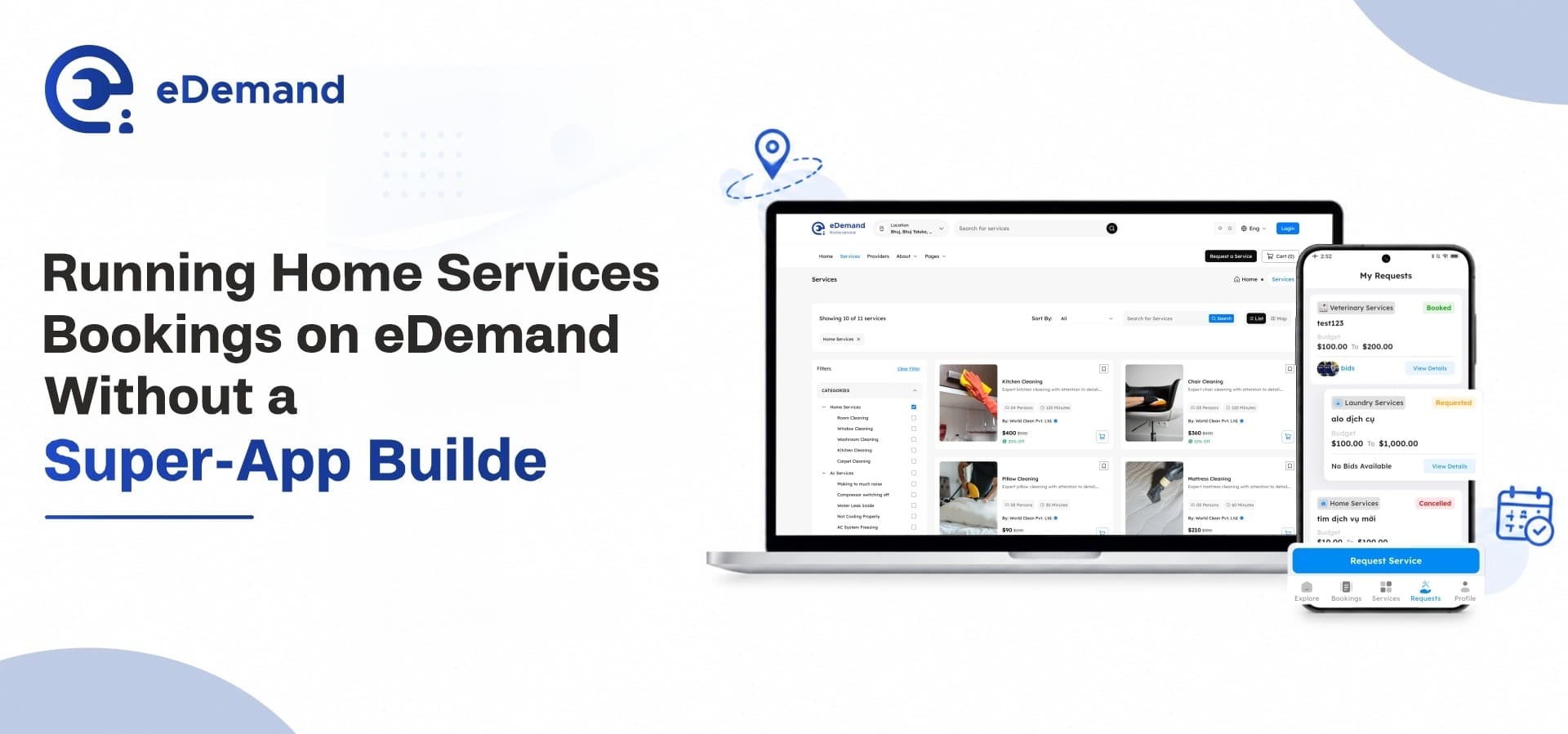
eDemand is scoped to that shorter list rather than a broader delivery or ride-hailing model. Here is how the core features map to what a home services launch actually needs.
Provider-Driven Marketplace
Providers manage their own services, pricing, profiles, and working hours directly inside the app. That means an admin does not have to manually create listings every time a new electrician or cleaner joins the platform. It also means the business can scale from ten providers to a much larger network without adding proportional admin workload.
Geo-Based Provider Discovery
Nearby providers surface automatically through Google Maps-based geolocation. There is no manual setup of countries, states, or cities to maintain as the service area grows, and customers see relevant options based on where they actually are.
Multiple Services in One Booking
Customers can add several services from the same provider into a single order instead of booking each one separately. A customer scheduling a plumbing job, for example, can add a related repair to the same visit rather than creating two separate bookings.
Smart Timeslot Suggestions
The platform calculates service duration automatically and recommends open timeslots based on provider availability. That removes the manual back-and-forth of confirming a time, which matters for home visits where the provider's schedule genuinely limits what is bookable.
Custom Job Request and Bidding
Not every home service request fits a fixed listing. Customers can post a job description with photos, and providers respond with bids. This gives the platform a way to capture non-standard requests, which is common in categories like repairs, renovations, or specialty maintenance work.
Revenue Options That Come Built Into the Platform
A home services platform also needs a way to make money from day one, and this is another area where a focused build works in the owner's favor rather than against it. eDemand supports more than one way to earn from the same booking activity:
-
Commission-based revenue, where the platform earns a set percentage on every booking a provider completes, so income grows automatically alongside booking volume
-
Subscription plans, where providers pay a monthly or yearly fee for continued access to the marketplace, creating predictable income that isn't tied to booking volume in any given month
-
A hybrid model, combining commission and subscription fees to capture revenue from both transaction volume and provider memberships
-
Advertisement revenue, through in-app ads that add a passive income layer without affecting the booking experience itself
None of these require separate development work once the platform is live. They are configuration decisions made from the admin panel, which means the business model can shift as the provider base grows without needing a new build.
Skipping the Custom Build for Home Service App Development
Founders who look into on-demand handyman app development from scratch typically find the same numbers coming back from agencies: several months of build time and a budget that starts in the tens of thousands once booking logic, provider tools, geolocation, and payment integration are all accounted for separately.
A ready-made platform changes that math because the booking flow, provider tools, and payment integration already exist and have already been tested in production. What's left is branding, configuring the service categories that fit the business, and setting commission or subscription terms. For a business that wants to be live and taking bookings within days rather than months, that difference in timeline is usually the deciding factor over building custom.
eDemand vs a Broader On-Demand Home Service App Build
There is a real difference between an on demand home service app scoped to handyman and repair categories and a platform designed to also handle a Gojek clone script-style spread of verticals such as ride-hailing, courier delivery, and food alongside home services.
A multi-vertical build makes sense when a business genuinely plans to operate across several unrelated service categories from day one and has the resources to manage that scope. For most home service founders, though, the actual goal is narrower: get providers listed, get customers booking, and get paid reliably. Choosing a platform scoped to that goal, rather than one built to eventually support ride-hailing or delivery it may never launch, keeps the setup simpler to run and easier to hand over to a small operations team.
Where eDemand Fits for Home Service Businesses
eDemand is built for exactly the scope described above: providers managing their own listings, customers booking by location and availability, and a platform owner collecting revenue through commission, subscription, or both. There is no unused dispatch logic or delivery routing sitting in the background, which keeps the admin panel focused on the metrics that actually matter for a home services business, such as active providers, completed bookings, and revenue by category.
Ready to launch your own home services booking platform? Explore eDemand on WRTeam Marketplace