Many marketplace owners start with one business, usually groceries. Then customers ask for medicines, a restaurant partner wants to join and a retailer asks to sell general products. The owner soon faces a decision: build or buy a separate app for each business, or run everything from one platform. The choice affects cost, workload and how quickly the business can grow. A multi vendor marketplace script with several modules built in offers one answer, while separate apps offer another.
This post compares eMarket with running separate apps for grocery, pharmacy and eCommerce. You will see where each approach works, where each one struggles and how to decide.
1. Two Ways to Run Several Business Lines
Both approaches can serve customers in several categories. What differs is how the pieces connect behind the scenes.
Separate Apps for Each Business
Each business gets its own customer app, its own backend, its own admin panel and often its own delivery setup. A grocery app, a pharmacy app and an eCommerce app live side by side, with little or nothing shared between them.
One Multi-Module Platform
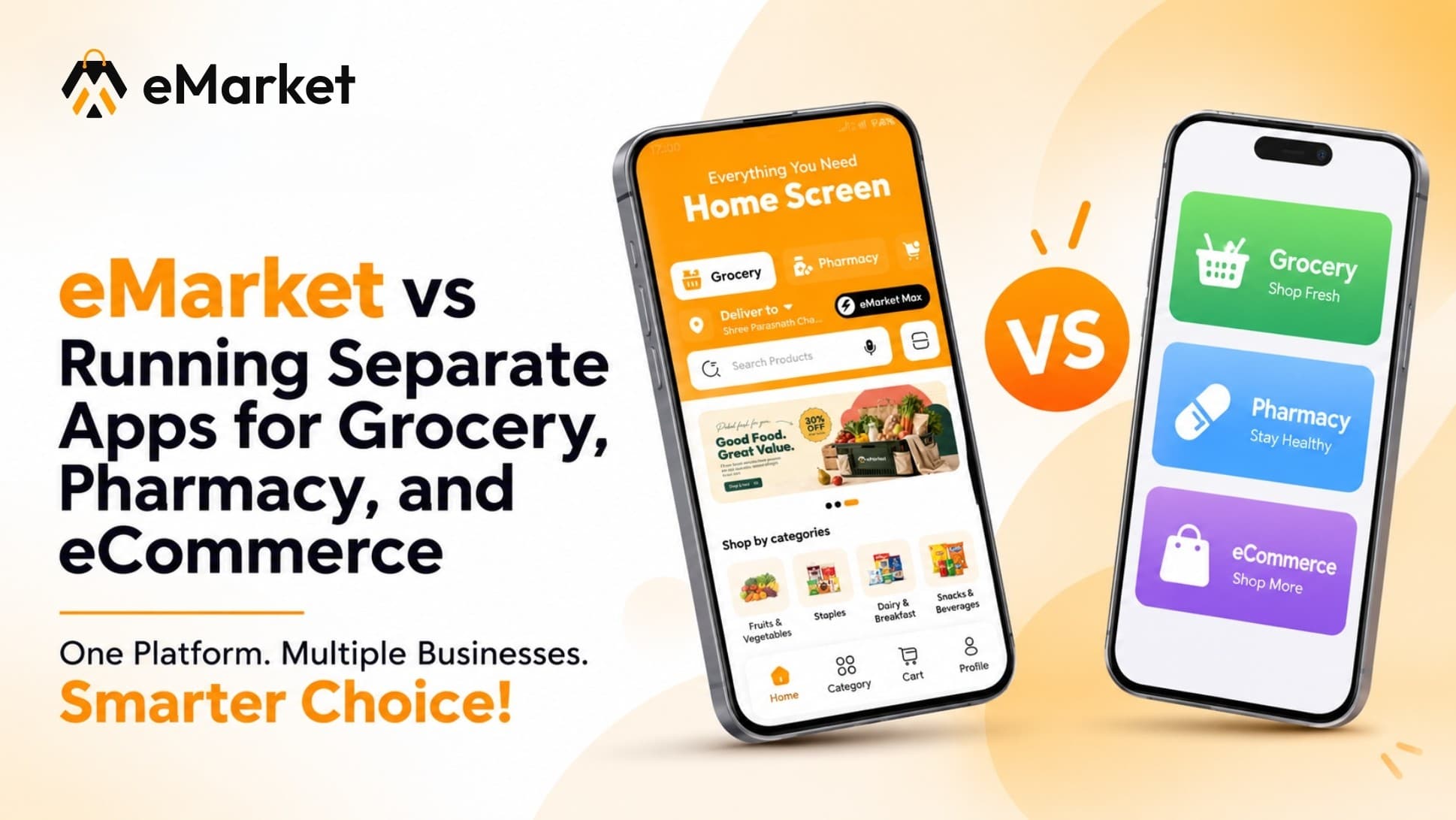
eMarket is a multi-vendor, multi-module marketplace. The product page describes one centralized admin panel, one backend, one customer application and one delivery management system, supporting Grocery, Pharmacy, eCommerce and Food Delivery modules that are available now. Parcel Delivery and Ride Booking are listed as planned modules.
The Core Difference
Separate apps multiply everything you build and manage. A multi-module platform shares the foundation and changes only what each business line needs. The sections below show what that means in practice.
2. Why Separate Apps Appeal
A fair comparison starts with what separate apps do well.
Clear Focus
A single-purpose app has one job. Its screens, rules and marketing message are all built around one type of customer, which keeps the product easy to understand.
Independent Launch and Change
Each app can launch, update and fail on its own schedule. A problem in one does not directly affect the others.
Different Teams and Brands
If each business has its own team, brand and goals, separate apps can match that structure. Teams can work without waiting for each other.
A Fair Summary
For businesses that are truly independent, separate apps can make sense. The difficulties start when the same owner runs all of them and wants them to share customers, sellers and delivery.
3. Where Separate Apps Become Costly
Every additional app brings repeated work.
Duplicated Foundations
Each app needs its own backend, admin panel, database and apps for customers, sellers and riders. Building or buying these several times costs more, and each copy must be maintained and updated.
Split Customers
A customer who orders groceries in one app and medicines in another becomes two separate customers. You lose the chance to cross-sell, and customers must install and learn several apps.
Repeated Seller Setup
A store that sells both groceries and general products may need to register more than once, with separate approvals and separate payouts.
Scattered Delivery
Separate apps often mean separate rider teams, separate cash collection and separate payout tracking. A rider who could serve several categories sits idle in one while another is short of drivers.
Fragmented Reporting
To see how the whole business performs, you must combine reports from several systems by hand.
4. Side-by-Side Comparison
The table below summarizes how the two approaches differ on the points that matter most.
This table describes the approaches in general. Check your own needs against any product you consider.
5. The Customer Experience Compared
Customers prefer fewer apps and fewer passwords.
One App, One Account
With eMarket, customers use one app for every module. A shopper who orders groceries on Monday can order medicines on Friday without installing anything new.
Location-Based Matching
The zone-based delivery system connects customers with nearby sellers, so people see options they can actually receive. This works across the different modules.
Consistent Order Tracking
Each order moves through a unified workflow with live status updates, whether it is a grocery basket, a medicine order or a general product. Customers learn the experience once and use it everywhere.
Offers That Reach Everyone
Marketing is simpler when everything sits in one app. Homepage sliders, promotional offers, popups, featured sections and promo codes can be managed in one place, and customers see offers across modules.
6. Sellers and Vendors Compared
A marketplace depends on its sellers.
One Seller System
A strong multi vendor ecommerce script gives you control over who joins and what they can do. In eMarket, admins can create seller accounts, review incoming registration requests, approve or reject applications and activate or deactivate accounts.
A Dedicated Seller Workspace
Sellers manage their stores, products, inventory, sales, returns and earnings from their own panel. They can track wallet credits and debits and view product and sales reports. Sellers with physical shops can also use the integrated Point of Sale system.
Policies and Wallets
Admins can manage seller privacy policies and terms from one place, and monitor seller wallet activity for accurate financial records. Withdrawal requests follow a clear approval workflow.
Why This Matters
In a separate-apps setup, every one of these tools exists several times over. In eMarket, you set them up once.
7. Delivery Operations Compared
Delivery is where shared infrastructure saves the most.
A Unified Delivery System
A grocery delivery platform that grew beyond groceries is a good description of eMarket's history. The product page notes that eMarket was originally developed as a grocery delivery platform before evolving into a multi-module ecosystem. Delivery partners now work from one workspace for assigned deliveries, progress updates, availability and earnings.
Managing the Delivery Team
Admins can add delivery partners, review registration requests, manage profiles and maintain delivery policies. Fund transfers, cash collections and salary records are tracked in the same system, so accounts stay transparent.
Payouts and Withdrawals
Sellers and delivery partners submit withdrawal requests, and admins review, approve or reject them and keep payout records.
Self-Pickup Option
A self-pickup workflow lets customers collect orders from the store, while admins monitor all pickup orders across the platform.
8. Keeping Each Business Line Flexible
The strongest argument for separate apps is that each business has its own rules. A multi-module platform has to answer this concern directly.
Module-Level Settings
eMarket lets you configure taxes, commissions, payments, banners and workflows independently for every business module. A pharmacy module can have different commission and workflow settings from a grocery module, even though both run on the same platform.
Module Management
A dedicated module management panel controls which modules are active and how each one operates. You can launch with one module and activate others as the business grows, without rebuilding anything.
Each Vertical, Its Own Needs
A multi vendor grocery app setup depends on fresh stock and fast delivery, while a pharmacy ecommerce platform handles products where accuracy matters. A multi vendor food ordering system is the most time-sensitive of all. Module-level settings let each vertical follow its own rules inside one platform. Pharmacy businesses should also check the local regulations that apply to their operation.
9. Revenue and Marketing Compared
A marketplace earns from many directions.
Revenue in eMarket
-
Marketplace commissions on orders across modules
-
Delivery and service fees
-
Featured listings, promotional banners and sponsored placements
-
Subscription plans with custom pricing, benefits and durations
Why Shared Revenue Tools Help
With separate apps, each revenue tool must be built or set up in every app. With one platform, a featured placement or subscription plan works across the marketplace. Expanding into a new module adds revenue streams without extra infrastructure.
One Marketing Message
One app, one brand and one customer base reduce marketing cost. Every promotion reaches the whole audience, instead of being repeated per app.
10. Technology and Maintenance Compared
Behind the scenes, the difference is just as large.
What You Receive
With eMarket, you receive multi vendor ecommerce app source code built with Flutter 3.x, Laravel, Firebase and Next.js, covering the customer app, seller and delivery apps, the web platform and the admin panel. Everything shares one codebase and one backend.
Updates and Administration
System administration tools handle platform updates, general settings and registration verification in one place. Technical configuration covers Firebase integration, notification templates, SMS gateways and SEO settings. With separate apps, each of these tasks is repeated.
Roles and Access
Role-based management lets you create internal users and assign permissions. Different team members can manage different parts of the marketplace without full access.
11. Cost and Effort Compared
Price is only part of the cost.
The License Price
At the time of writing, the eMarket Regular License is listed at $39 and the Extended License at $799. Both are one-time licenses with lifetime validity and free updates. The Extended License adds a ready-to-launch configuration for Android, iOS, Web and Admin Panel, with six months of dedicated support.
The Cost of Duplication
Several separate apps mean several licenses or builds, several servers and several maintenance routines. The product page states that shared backend, admin panel, database and delivery infrastructure reduce development and maintenance costs, and that ready-to-use apps, admin panel and website speed up launch.
Costs That Apply to Both
Hosting, Firebase usage, SMS gateway fees, payment gateway fees and marketing apply either way. Plan for them from the start.
12. When Separate Apps Still Make Sense
An honest comparison also says when a single platform may not fit.
Good Reasons to Keep Apps Separate
Separate apps may be the better choice if:
-
The businesses have different owners, brands and teams
-
Each business needs deep, unique features that a shared platform does not cover
-
You already run mature apps and have no reason to change them
-
Regulatory or contractual reasons require strict separation
Signs You Need One Platform
Consider eMarket when:
-
One owner runs several business lines
-
You want customers, sellers and riders to work across categories
-
You want one admin panel and one set of reports
-
You plan to add new categories over time
13. A Simple Decision Checklist
Use this list to judge your own plans:
-
List the business lines you want to run in the first two years.
-
Note which ones share customers, sellers or delivery.
-
Estimate the cost of a separate app for each line.
-
Check whether module-level settings cover the rules each line needs.
-
Decide which module to launch first.
-
Choose the approach that serves your list with the least duplicated work.
Where eMarket Fits
eMarket suits entrepreneurs, startups and agencies that want one marketplace for groceries, medicines, general products and food, with the option to add more modules later. You get customer, seller and delivery apps, a web platform and an admin panel in one package, and you can start with a single module and grow from there.
Run Every Business Line From One Platform
Ready to launch grocery, pharmacy and eCommerce under one marketplace? Explore the features, demo and license options for eMarket on the WRTeam Marketplace.