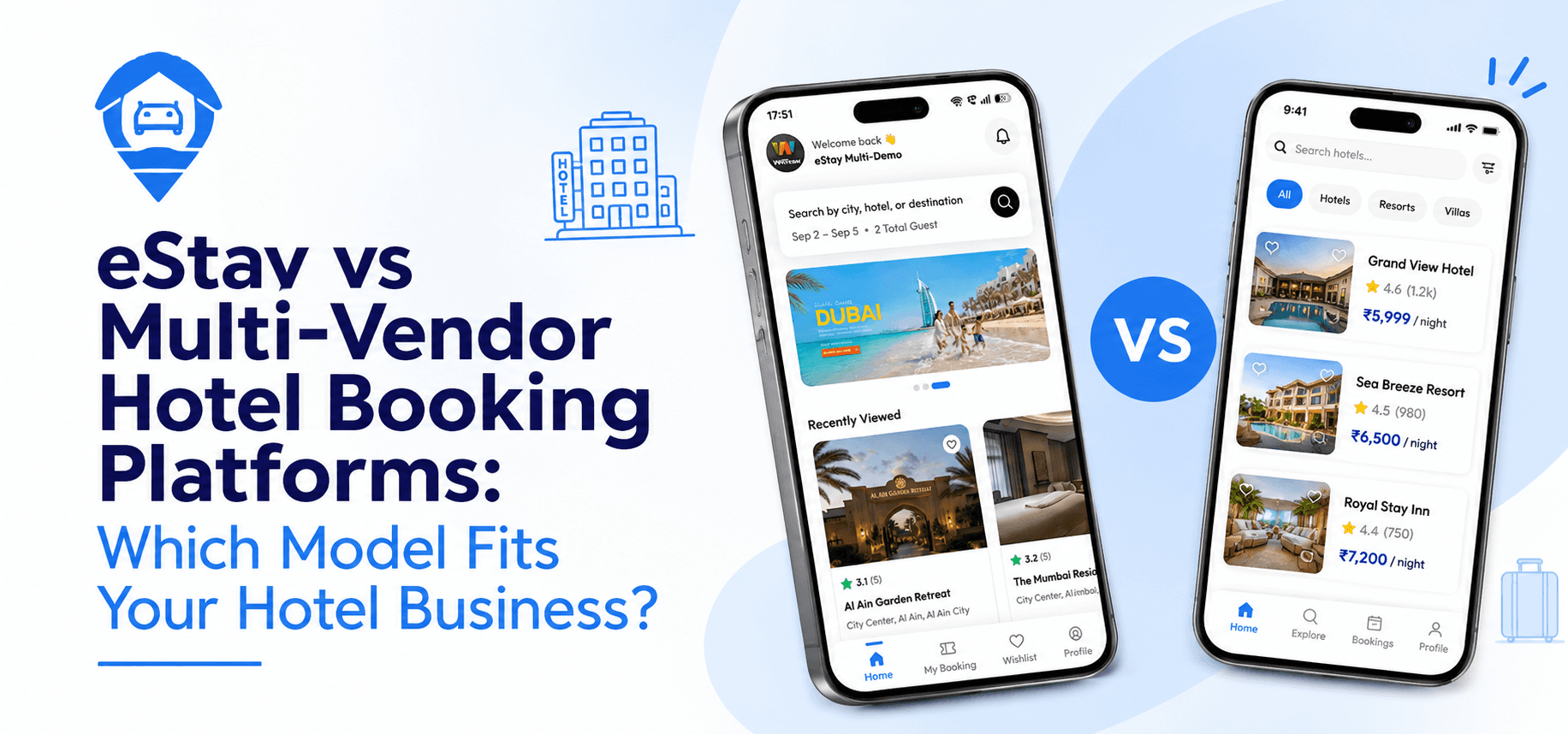
Before choosing software, a hotel business needs to answer a bigger question: are you running your own property, or are you building a place where many property owners list theirs? The answer shapes your revenue, your workload and the tools you need. A hotel booking management system built for one model can feel awkward when used for the other, so it pays to decide early.
This post compares the single-property model with the multi-vendor marketplace model, and shows where eStay fits. eStay supports both, which makes the comparison useful whichever direction you lean. You will see how each model earns, how each one operates and what each one asks of you.
1. Two Business Models Explained
Both models sell hotel stays online, but they sit at different points in the hospitality chain.
The Single-Property Model
You own or operate one hotel, resort or villa, or a small group of them. Guests book directly with you through your own website and app. You manage rooms, prices, guests and staff, and you keep the booking revenue.
The Multi-Vendor Model
You build a marketplace where independent property owners list their hotels, resorts, villas, apartments or homestays. Guests browse many properties, and you earn a commission on bookings. Property partners manage their own listings, while you manage the platform.
Where eStay Fits
eStay is a complete hotel booking and management platform with a Flutter mobile app, a Next.js PWA website and a Laravel admin panel. It supports single-property and multi-property businesses, with a single hotel panel for one property and a multi-hotel panel with a dedicated Partner Panel for marketplaces.
2. What Each Model Does Well
A fair comparison starts with the strengths of both.
Strengths of the Single-Property Model
-
Full control over your brand, prices and guest experience
-
Direct relationships with guests
-
Simpler operations, since you manage one business
-
No need to recruit property partners
Strengths of the Multi-Vendor Model
-
A wider choice of properties for guests
-
Commission income that grows with every partner
-
A scalable business that does not depend on owning rooms
-
The ability to cover many locations without owning a single property
A Fair Summary
Neither model is better in general. The single-property model suits owners who already have rooms to sell. The multi-vendor model suits entrepreneurs who want to build a marketplace around other people's properties.
3. Where Each Model Strains
Every model has its own difficulties.
Challenges in the Single-Property Model
Your income depends on your own rooms. When occupancy is low, there is no other source of revenue unless you add events, promotions or new properties. You also carry the full marketing effort for a single brand.
Challenges in the Multi-Vendor Model
A marketplace needs supply and demand at the same time. You must recruit property partners, verify them, handle payouts and keep guests satisfied across many different properties. Quality control becomes a daily task, because a poor experience at one property reflects on your whole platform.
Why This Matters for Software
Each challenge needs different tools. A single-property owner needs a strong calendar and booking flow. A marketplace owner needs partner onboarding, verification, commissions and payouts.
4. Side-by-Side Comparison
The table below summarizes how the two models differ on the points that matter most.
This comparison describes models in general. Check the details of any platform you consider against your own requirements.
5. Revenue Compared
Money works differently in each model.
Single-Property Revenue
A single property earns mainly from room nights, and eStay lets owners choose full online payment, partial advance or pay-at-property for each listing. Online payments run through Stripe, Razorpay and Flutterwave. Events and venue bookings add inquiry-based income, and promo campaigns and referral rewards help fill quiet periods.
Multi-Vendor Revenue
A marketplace earns a commission on every successful booking generated through partner properties. As more owners join and grow, income scales without you owning a single room. Partners can see wallet earnings, request withdrawals and track payouts.
Growing Across Branches
Hotel groups can also expand within the same system. eStay supports multi-branch and multi-country management from a single login, with country-wise taxes, currencies and branch-level reporting, so growth stays organized.
6. Operations Compared
Daily work looks very different in the two models.
Managing Rooms and Availability
A property owner needs an accurate picture of what is available. A hotel room booking system that shows room types, inventory and an availability calendar prevents double bookings and keeps guests happy. In eStay's single hotel panel, you manage room types, inventory, the availability calendar, facilities, property rules and check-in and check-out operations from one place.
Managing Partners
In a marketplace, the work shifts to partners. eStay's Partner Panel gives property owners their own dashboard to manage properties, locations, bookings, check-ins, room settings, cancellation policies, reviews, notifications and wallet earnings. Admins handle partner verification, including KYC and document management, along with commissions and payouts.
Staff Access
Role-based access lets you assign each team member to the modules they need, from front-desk booking management to finance-only refund access. This reduces risk as your team grows, in either model.
Daily Convenience
A practical hotel management app reduces the daily work of busy teams. The admin dashboard shows bookings, occupancy, revenue and staff activity, with quick-action cards that make routine tasks faster.
7. Guest Trust and Brand Compared
Guests choose based on trust, and each model builds it differently.
Trust in a Single Brand
When guests book directly with one hotel, the brand carries the trust. Photos, reviews and the quality of the stay all reflect on one name. Guest reviews appear on property pages, and you can manage them from the panel.
Trust in a Marketplace
In a marketplace, guests trust the platform first and the property second. That makes review management, partner verification and clear cancellation policies especially important. eStay includes review moderation for admins and cancellation policy management for partners.
Protecting Guests and Income
Both models benefit from cancellation and refund management and from clear property rules. When policies are visible and consistent, guests book with more confidence.
8. Technology and Discovery Compared
Guests need to find you before they can book.
One Product, Two Setups
eStay combines a Flutter mobile app, a Next.js website and a Laravel admin panel built on Filament v5 with MySQL. The product page shows separate demos for the single hotel setup and the multi hotel setup, so you can see how each one works before you decide.
A Website That Can Be Found
Strong online hotel booking software helps guests discover you, not just process payments. The eStay website installs as a Progressive Web App and uses SEO-friendly pages, which helps properties appear in organic search. A content management system and blog module let you publish hospitality content that brings in more visitors.
Search and Browsing
Guests can use adaptive property search and filters, open detailed property and room pages, and book with instant confirmation. In a marketplace, these tools help guests compare many properties quickly.
9. Cost and Effort Compared
Price is only part of the cost.
The License Price
At the time of writing, the eStay Regular License is listed at $19 and the Extended License at $799. Both are one-time licenses with lifetime validity and free updates. The Extended License adds a ready-to-launch configuration for Android, iOS, Web and Admin Panel, with six months of dedicated support.
The Effort Behind Each Model
A single-property owner mainly spends effort on marketing and daily operations. A marketplace owner spends effort on recruiting partners, handling verification and managing payouts, and must reach a point where enough properties and guests exist to keep the platform active.
Costs That Apply to Both
Hosting, payment gateway fees, email services and marketing apply in either case. Plan for these costs when you compare totals.
10. Which Model Fits Which Owner
Different owners reach different conclusions.
Owners Who Often Suit the Single-Property Model
-
Boutique hotel and resort owners who want direct bookings
-
Independent villa or homestay owners with a few units
-
Hotel groups that manage their own branches
Owners Who Often Suit the Multi-Vendor Model
-
Entrepreneurs building a regional travel marketplace
-
Agencies creating a booking portal for a local tourism area
-
Businesses that want commission income without owning rooms
The Property Types
eStay supports hotels, resorts, villas, apartments, homestays and dharamshalas. A villa booking app or homestay portal can therefore use either model, depending on whether you list your own villas or invite other owners to list theirs.
11. A Simple Decision Checklist
Use this list to judge your own plans:
-
Decide whether you own rooms or want to list other people's.
-
Estimate how many properties you could realistically onboard.
-
Decide how you want to earn: room bookings, commission or both.
-
List the tools you need most, such as calendar, check-in, partner verification or payouts.
-
Estimate marketing and operating effort for each model.
-
Test the demos for both setups before you choose.
Where eStay Fits
eStay suits hotel owners, groups and entrepreneurs who want a ready-made booking platform with apps, a website and admin tools, whether they run one property or a marketplace of many. You get the booking, payment, staff and promotion tools in one package, and you can start with the model that matches your business today.
Choose the Model That Fits Your Hotel Business
Ready to launch a hotel booking platform that matches your plans? Explore the features, demos and license options for eStay on the WRTeam Marketplace.