Running a hotel, resort, villa, or homestay usually means juggling a booking diary, a spreadsheet for room availability, a separate payment tracker, and a handful of messaging apps to coordinate with guests. Most owners don't start out looking for software, they start out looking for a way to stop double-booking rooms and chasing down payments manually.
That's where a proper hotel booking management system changes the day-to-day. Instead of stitching together spreadsheets, WhatsApp threads, and a walk-in register, everything from room availability to guest check-in lives in one dashboard. This post walks through what eStay actually does, which modules matter for a single-property business, and how the platform grows with you if you later decide to add branches or open up a partner network.
What Is eStay
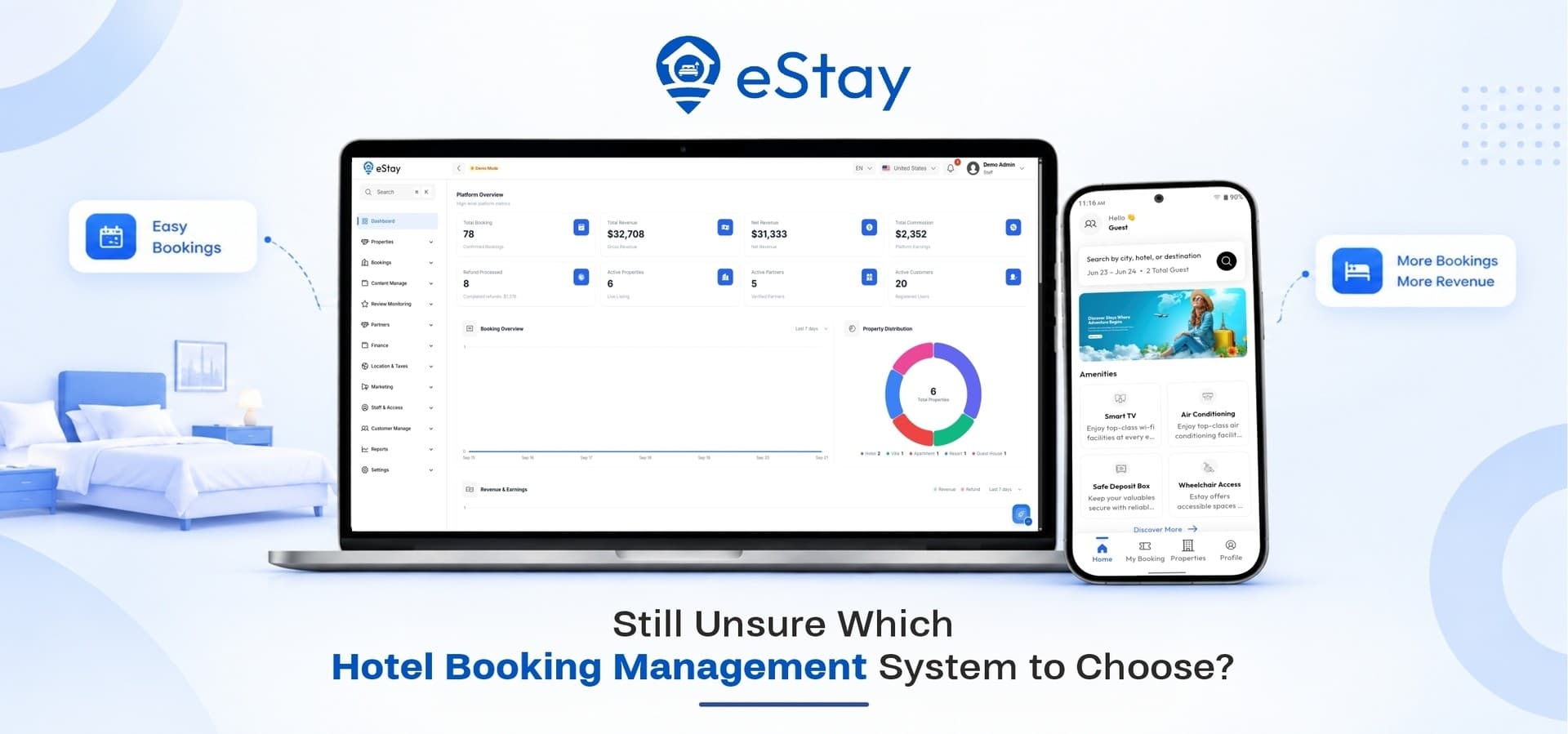
eStay is a hotel booking and management platform built around three connected pieces: a Flutter mobile app, a Next.js progressive web app for guests, and a Laravel admin panel that runs the backend. Together they form a complete hotel management app ecosystem, covering everything a hotel, resort, villa, apartment, homestay, or dharamshala needs to take bookings and run daily operations.
The platform is designed for two ownership models:
-
Single-property owners who want one dashboard for one location, without paying for multi-vendor complexity they don't need.
-
Multi-property or partner-based businesses that eventually want to onboard other property owners through a dedicated Partner Panel.
Because both models sit on the same core system, a single-property business isn't locked out of scaling later. The admin structure, booking engine, and payment logic stay consistent whether you're running one boutique property or fifty listings across multiple countries.
Why That Matters for a Single-Property Business
A lot of hotel software is built multi-vendor first, which means single-property owners end up paying for and navigating features they'll never touch: partner onboarding, commission splits, marketplace-style listings. eStay's architecture lets a single-property business run lean from day one, while keeping the door open if the business grows into something bigger.
Core Modules That Run the Business
Room Inventory and Availability
Every booking depends on room data being accurate in real time. eStay's inventory tools let you set up room types, categories, and rates, then track availability through a live calendar so the same room can't be sold twice across the app, website, and front desk simultaneously.
Booking and Reservation Management
The admin panel centralizes every reservation, whether it came through the app, the website, or a walk-in entry made by staff. Booking status, guest details, and payment state are all visible from one screen instead of being scattered across a notebook and a phone.
Guest-Facing App and Website
Guests can search properties, filter by amenities, view detailed room pages, and complete a booking through the Flutter app or the PWA website. Because the website is installable as a Progressive Web App, it behaves like a native app in the browser while still being indexable by search engines, which is useful for organic discovery.
Flexible Payment Configuration
This is one of the more practical features for single-property owners. Instead of forcing one payment model on every booking, eStay lets you choose full online payment, a partial advance, or pay-at-property, configurable per listing. An online hotel booking software setup like this protects cash flow on high-demand dates while still giving guests booking flexibility when they'd rather pay on arrival.
Promo Codes and Referral Program
Built-in discount campaigns and referral rewards give owners a way to attract new guests and encourage repeat stays without bolting on a separate marketing tool or tracking coupons by hand.
Role-Based Staff Access
As soon as more than one person touches the front desk, permission control matters. Staff roles can be restricted to relevant modules only, so a front-desk employee handles bookings while refund approval stays limited to finance-level access.
Who eStay Is Built For
-
Boutique hotel owners who want one clean system instead of a general-purpose booking script.
-
Resort and homestay operators who need room-type and pricing flexibility beyond a basic room list.
-
Villa rental businesses running a villa booking app experience for guests who expect an Airbnb-style search and booking flow, but want their own branded platform instead of a third-party marketplace listing.
-
Dharamshala and guesthouse managers who need simple, dependable booking and check-in tools without unnecessary complexity.
-
Growing hotel groups that start with one property but want software that won't need replacing once a second or third location opens.
Why Choose WRTeam's eStay
Picking hotel software isn't just about the feature list on launch day. A few things matter more over the long run:
-
Continued updates. eStay is actively maintained, with the current release adding refinements across the admin, partner, and guest experience.
-
Documented setup. Full documentation and demo credentials are available before you commit, so implementation isn't a guessing game.
-
A real support structure. Buyers get technical support post-purchase, with extended license holders receiving backend deployment assistance and a longer maintenance window.
-
Room to grow. Because single-property and multi-property modes share the same core, upgrading operationally later doesn't mean migrating to different software.
What to Look for Before You Pick a Hotel Booking Platform
Feature lists can look similar across hotel software until you actually try to run a property on one. Before committing to any platform, it helps to know which modules are genuinely necessary versus which ones sound good in a sales pitch but rarely get used. Complete guide to evaluating hotel booking software (Link: to be added once published) breaks that down in more detail if you want a fuller checklist before deciding.
Keeping Room Availability Accurate Across Every Booking Channel
One of the fastest ways to damage guest trust is a double-booked room. It usually happens when availability is tracked in more than one place: a spreadsheet for walk-ins, a separate calendar for online bookings, and a mental note for phone reservations.
A hotel room booking system built around a single live calendar removes that risk. Every booking, regardless of channel, updates the same inventory record. Owners get a few practical benefits from this:
-
Fewer manual reconciliations at the end of each day or shift.
-
Accurate rate management across room types without re-entering data in multiple places.
-
Faster front-desk decisions, since staff see live availability instead of checking with someone else first.
For a single-property business, this alone is often the difference between hotel software feeling like a burden versus feeling like it's actually saving time.
Growing Bookings Without Relying on Third-Party Listing Sites
Many boutique properties start out entirely dependent on third-party booking sites, which means paying commission on every reservation and having limited control over guest relationships. A direct booking engine changes that equation. When guests book straight through the property's own app or website, the owner keeps the full margin and the guest data needed for repeat marketing, referrals, and loyalty offers.
This matters most for smaller, independent properties trying to build a guest base without leaning entirely on commission-based platforms for every reservation.
Deciding Between a Single-Property Setup and a Partner-Based Model
Not every hotel business needs a partner network from day one. Some owners run one property and want to keep it that way. Others plan to onboard additional property owners eventually, turning their platform into a small marketplace with commission and payout tracking built in.
The right choice depends on the business model, not just the software. A single-property setup keeps operations simple and avoids unnecessary partner-management overhead. A multi-vendor setup makes sense once there's a real plan to onboard other properties and manage commissions and payouts at scale. Understanding which model fits your business before you configure the platform saves a lot of rework later.
Handling Guest Check-In and Payments as the Business Grows
Check-in and payment tracking are two areas where manual processes break down fastest as booking volume increases. Automated check-in status updates, along with clear payment records for advance payments, balances due, and refunds, keep front-desk staff from having to cross-reference a separate ledger for every guest. As a property adds rooms, staff, or a second location, having this built into the same system that handles bookings and inventory keeps operations from fragmenting into multiple disconnected tools.
Get Started with eStay
If you're running a single property and tired of juggling spreadsheets, booking diaries, and manual payment tracking, eStay gives you one system built for exactly that, with room to grow if your business expands. Explore the full feature set and license options here: eStay – Hotel Booking Management System