Every city has drivers looking for consistent income and riders who want a car to show up in minutes, not hours. The businesses that win in this space are not the ones with the biggest advertising budget. They are the ones running on software that can handle live tracking, fair driver matching, and city-specific pricing without falling over during rush hour.
That is the gap eTaxi is built to close. It gives fleet owners, transportation startups, and mobility agencies a ready-to-launch taxi booking app with a customer app, a driver app, and an admin panel that already handles the operational details most teams underestimate until they are live. This post walks through what eTaxi actually includes, who it fits, and how the platform turns ride volume into recurring revenue.
What Is eTaxi?
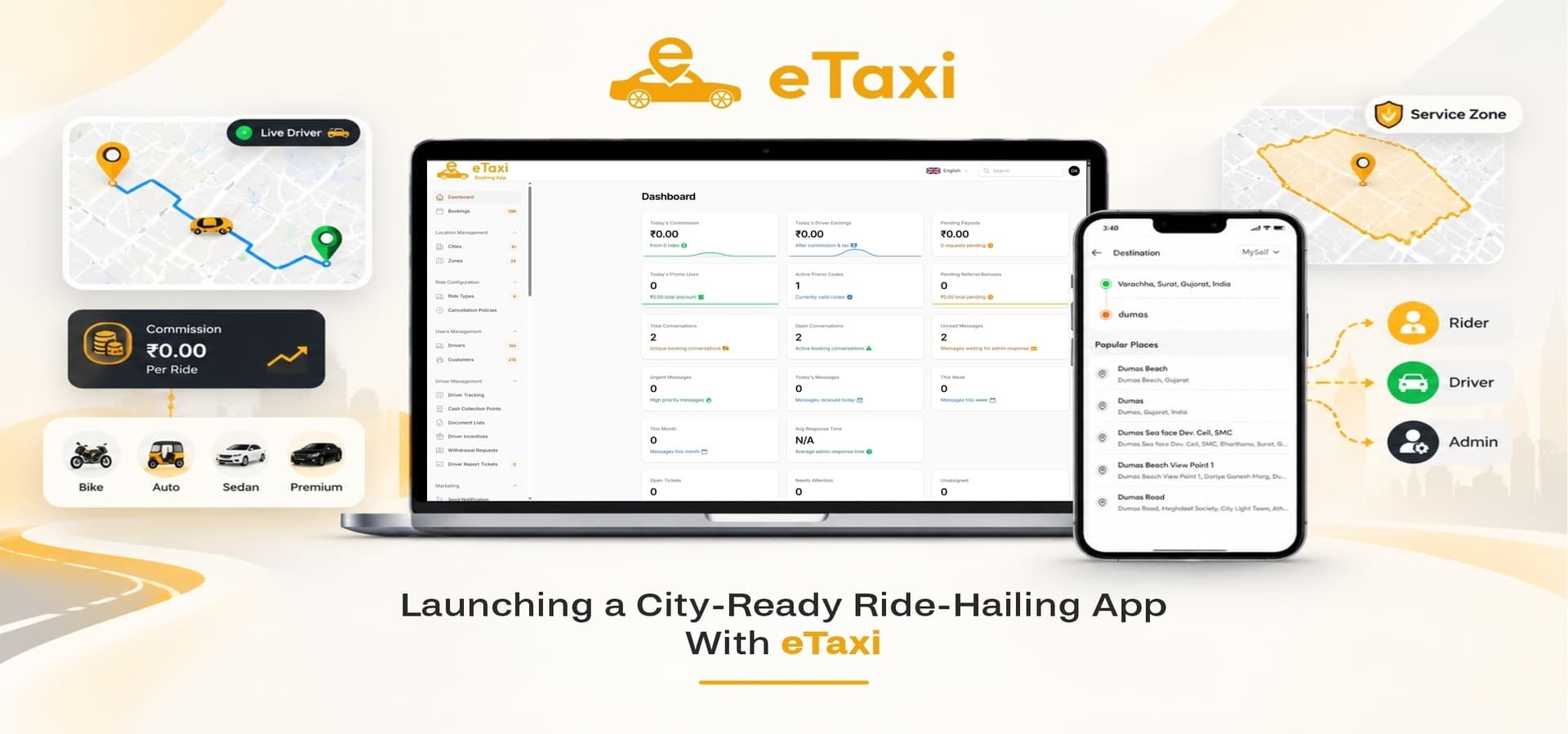
eTaxi is a complete ride-hailing solution built on Flutter for the customer and driver apps, with a Laravel admin panel, a MySQL database, and WebSocket connections that keep location tracking, fare calculation, and trip status updating in real time. That combination is what separates working taxi management software from a booking form bolted onto a map.
The platform integrates Google Maps for navigation and live tracking, Razorpay and Stripe for payments, and Firebase Cloud Messaging for trip notifications. None of that needs to be built or connected manually. It ships configured and ready to test through the demo apps before you commit to a license.
Who eTaxi Is Built For
-
Fleet owners replacing manual dispatch with a structured, app-based booking flow
-
Transportation startups launching a new cab service in one or several cities
-
Agencies building white-label mobility apps for local clients who want their own branded platform
Core Modules and Features
eTaxi is organized around three connected apps. Each one is built to remove a specific point of friction in the ride-hailing process.
Rider App Highlights
The customer side is where trust is won or lost, so the feature set focuses on transparency at every step.
-
Instant booking with pickup and drop selection inside active service zones
-
A cab booking app experience with multiple vehicle categories, including bike, auto rickshaw, sedan, and premium options
-
Upfront fare estimates and ETA before the rider confirms a trip
-
A digital wallet for refunds, promo credits, and partial trip payments
-
In-app chat and calling with the assigned driver once a ride is accepted
-
Digital trip receipts with a full breakdown of fare, taxes, and discounts
-
Post-trip tipping, driver ratings, and a refer-and-earn program
Driver App Highlights
Driver retention depends on clarity and fairness, and the driver app is built around both.
-
A guided registration flow for personal details, vehicle information, and required documents
-
Online and offline toggles so drivers control exactly when they receive requests
-
A response window for accepting or rejecting ride offers based on proximity and rating
-
Turn-by-turn navigation and arrival confirmation for smoother pickups
-
OTP-based trip start to confirm the right rider and driver are matched
-
A live earnings wallet showing net income after commission, plus daily and weekly summaries
Admin Panel Capabilities
This is where the business side of eTaxi runs, and it is built for operators managing more than one city.
-
City and zone management using polygon-based boundaries for precise service areas
-
Ride type management for vehicle categories, availability, and driver eligibility
-
City-wise fare, commission, and revenue configuration, giving you true cab management software control over margins
-
Promo code and discount campaigns with usage limits and performance tracking
-
A dynamic driver onboarding workflow for document review, approval, and resubmission requests
-
Live ride monitoring and historical trip search for full operational visibility
-
Refund and adjustment handling with a full audit trail
-
Configurable document requirements that update across the fleet without code changes
-
Zone-wise surge pricing rules for weekends, holidays, and peak demand windows
-
A unified support inbox and city-wise tax management for compliant, accurate billing
Together, these modules give an operator a genuine online taxi booking system, not a stripped-down booking widget with a few admin toggles bolted on.
Monetization Built Into the Platform
A ride-hailing app only matters if it makes money reliably. eTaxi has three revenue streams built in from day one.
Commission Fees
Every completed ride automatically deducts a configurable commission before the balance is credited to the driver's wallet. This is the core recurring revenue line for any taxi platform, and it scales on its own as ride volume grows.
Surge and Peak-Hour Pricing
Demand-based pricing multipliers apply during rush hours, bad weather, or local events, and they can be set independently per city and zone. Riders pay a fair adjusted rate, and the platform captures more value exactly when demand is highest.
Cancellation Fee Revenue
Configurable cancellation charges apply when a rider or driver cancels after a match is already confirmed. This protects driver time and fuel costs while discouraging casual misuse of the booking system.
Why Choose WRTeam's eTaxi
Building a comparable platform from scratch usually means months of development, a team that understands real-time systems, and ongoing maintenance once it launches. eTaxi replaces that with a ride booking app you own outright, source code included, with no per-ride revenue share going back to a third-party vendor.
A few things set it apart from generic uber clone apps sold as one-size-fits-all templates:
-
Full source code ownership under the license terms, not a rented SaaS seat
-
Polygon-based zone intelligence for real city-by-city and even neighborhood-by-neighborhood control
-
A fair driver matching engine using proximity, rating, and fallback logic instead of simple broadcast assignment
-
Multi-vehicle support (bike, auto, sedan, premium) inside a single app rather than separate builds
-
An Extended License option with ready-to-launch setup, meaning the WRTeam team handles backend deployment and domain configuration so drivers and riders can be onboarded within weeks
Agencies building a white label taxi app for clients get the same advantage: a proven, real-time codebase they can brand and deploy repeatedly instead of re-engineering core ride logic for every new client.
What to Look for Before You Choose a Platform
Not every taxi app on the market handles zone pricing, driver matching, or surge logic the same way, and the gaps usually do not show up until you are already live with real drivers on the road. Before committing to any platform, it helps to know exactly which features separate a genuinely operational system from one that only looks complete in a demo video. The full checklist of features to evaluate before choosing a taxi booking platform breaks down what to check first, from fare configuration to driver document handling.
Real-Time Tracking and Fare Accuracy
Riders expect their ETA and fare estimate to be accurate before they ever get in the car, and drivers expect fare calculation to reflect the actual route taken. That combination depends on how location data, distance calculation, and pricing rules interact behind the scenes, which is where a lot of budget taxi scripts start to fall apart under real traffic conditions.
Turning Peak-Hour Demand Into Revenue
Surge pricing sounds simple until you are trying to apply it fairly across multiple cities, each with different demand patterns, without frustrating riders or under-paying drivers during the busiest hours. Getting this right is often the difference between a platform that breaks even and one that actually compounds revenue during rush hour, weekends, and local events.
Building Your Own Fleet vs Using an Aggregator
Plenty of operators start by listing drivers on an existing aggregator app before realizing how much margin, branding, and customer relationship they are giving up in the process. Owning the platform outright changes that equation, but it also means taking on decisions an aggregator used to handle for you.
Onboarding Drivers the Right Way
A slow or confusing driver onboarding process is one of the fastest ways to lose good drivers before they ever complete a single trip. Document verification, approval timelines, and clear rejection reasons all affect how quickly a new market gets enough active drivers to make rider wait times competitive.
Ready to Launch Your Ride-Hailing App?
eTaxi gives you a real-time, city-ready taxi platform with full source code ownership, built-in monetization, and a driver and rider experience designed for retention. Explore the full feature set and licensing options on the eTaxi product page.