Coaching centers, training institutes, and single-campus schools face a strange gap in the software market. Most learning management software is built either for solo creators selling a handful of courses or for sprawling multi-tenant networks serving dozens of organizations at once. If you're running one institution and want full ownership of your platform, neither extreme fits well.
eLMS is built for that middle ground. It gives a single institution a complete, self-hosted learning environment, with the option to grow into a multi-instructor academy later if the business calls for it. This post walks through what eLMS actually includes, who it suits, and what to check before you commit to any platform for delivering and selling courses online.
What Is eLMS
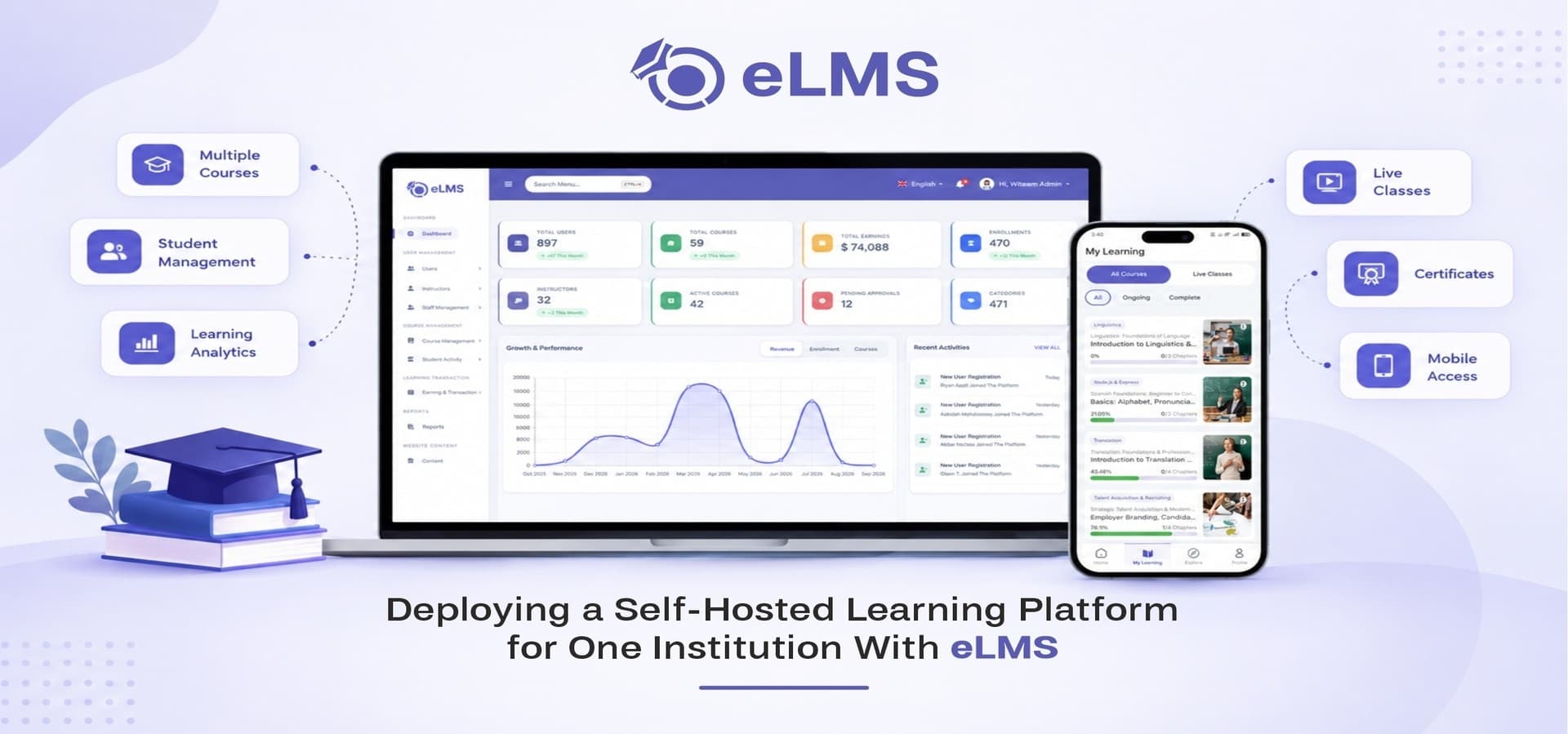
eLMS is a ready-to-launch learning management systems source code built on Flutter for the mobile apps, Next.js for the web platform, and a Laravel admin panel for backend operations. Together, these three layers form a complete eLearning ecosystem that an institution can deploy under its own name rather than renting space inside someone else's platform.
Unlike SaaS-based LMS products where your institution is one tenant among many on shared infrastructure, eLMS is source code you own and host. You control the server, the branding, the data, and the pace of updates. For a single institution that wants a dependable online learning management system without ongoing per-seat SaaS fees, that ownership model is the core appeal.
The platform works equally well in two setups:
-
Single-instructor academy: one institution publishing and managing all of its own course content
-
Multi-instructor marketplace: multiple educators publishing and selling courses under one umbrella, with commissions and payouts handled automatically
Because both modes run on the same codebase, an institution that starts small can expand into a marketplace model later without switching platforms.
Tech Stack Behind eLMS
Each layer of eLMS was selected for performance and ease of customization:
-
Flutter: a single codebase powering both Android and iOS apps
-
Next.js: the learner and instructor-facing web platform
-
Laravel: the admin panel and backend logic
-
Firebase: real-time notifications and messaging support
-
MySQL: the underlying database
-
REST APIs: connecting the mobile, web, and admin layers
This combination means an institution isn't stitching together separate tools for its lms website, mobile apps, and back office. All three run from one connected system, which keeps maintenance and updates simpler over time.
Key Modules and Features
Course Building and Delivery
Instructors can structure courses into sections, lessons, and assignments, then deliver video content through HLS adaptive streaming. HLS support means playback adjusts to a learner's connection speed and device, which matters for institutions serving learners on inconsistent mobile data. Secure video management and encoding also help protect paid course content from casual downloading or redistribution.
Certification and Assessment
Courses can include quizzes, graded assignments, and certificates issued on completion. For coaching institutes and training organizations where a certificate is part of the value proposition, this closes the loop between "watched the content" and "proved they learned it."
Multi-Instructor and Team Collaboration
Beyond solo course creation, eLMS supports team instructor accounts, where more than one person can co-manage a single course. This is useful for institutions producing higher-production courses that need a subject expert, an editor, and a course designer working from the same dashboard rather than passing files back and forth.
Admin Analytics and Reporting
The Laravel admin panel centralizes enrollments, revenue, instructor performance, learner engagement, and course completion data. An institution running its own online course selling platform needs this visibility to know which courses are working, which instructors are performing, and where learners are dropping off.
Apps for Android and iOS
Learners get native mobile apps built from a single Flutter codebase, so the institution covers both app stores with one development investment rather than maintaining two separate native builds.
Who eLMS Is Built For
eLMS fits a specific kind of buyer: an institution that wants to own its learning platform outright rather than lease access to a shared SaaS product. That typically includes:
-
Coaching institutes moving their in-person curriculum online
-
Training organizations that need certification tracking built in
-
Schools and universities running supplementary or extension courses
-
Entrepreneurs starting a course business from scratch, either solo or with a roster of instructors
What connects these buyers is a preference for a platform they control end to end, rather than one where their content and student data sit on infrastructure managed by a third party. Institutions in this position are often past the point of trusting a generic website builder with course sales, but they're not large enough to justify the cost or complexity of enterprise LMS software built for hundreds of tenants. eLMS sits in that space intentionally, sized for one institution's course catalog and student base rather than a shared multi-tenant network.
License Options and What They Include
WRTeam offers two license paths for institutions deploying eLMS, and the right choice depends mostly on how much setup work the institution wants to handle internally.
Regular License
The regular license includes the complete source code, lifetime validity with free updates, permission for one domain, and six months of general and technical support. This suits institutions with an in-house developer or agency partner who can handle deployment and configuration.
Extended License
The extended license adds ready-to-launch configuration across Android, iOS, web, and the admin panel, plus three months of maintenance support on top of the standard package. WRTeam's engineering team handles backend deployment and domain server setup directly, which shortens the gap between purchase and a live, functioning platform for institutions without dedicated technical staff.
Why Choose WRTeam's eLMS
Building an LMS with course builders, certification tracking, secure video delivery, and payment processing from the ground up can take months of development time and a meaningful budget before a single course is ever sold. eLMS removes that barrier by shipping as white-label software that's ready to rebrand, configure, and deploy.
A few things set the WRTeam build apart for institutions evaluating a white label lms app:
-
Complete ownership: the source code, branding, and hosting are yours, not rented
-
Revenue tools built in: course sales, marketplace commissions, coupons, wallet top-ups, and App Store-compliant in-app purchases are already wired into the platform
-
Ongoing support and updates: buyers get technical support and continued software updates rather than a one-time code drop with no path forward
-
Ready-to-launch configuration: with the extended license, WRTeam's team handles backend deployment and domain server configuration, so the institution isn't left to figure out hosting alone
What to Look for Before Choosing a Learning Platform
Course structure and video delivery are only part of the decision. Certificate design, assignment grading workflows, payment gateway coverage, and how a platform handles multiple instructors all shape whether a system actually fits daily use once real students are enrolled. Rather than list every consideration here, it's worth working through 8 features to look for in a self-hosted learning management system, which breaks down exactly what to check before signing off on any platform.
Structuring Courses So Certificates Actually Mean Something
A course that ends without a clear finish line rarely holds a learner's attention through to completion. How an institution breaks content into sections, sequences assignments, and ties a certificate to genuine completion criteria has a direct effect on both learner outcomes and how credible that certificate looks to an employer or accrediting body reviewing it later. Getting the structure right early avoids a rebuild once the first cohort has already enrolled.
This matters more for institutions than for individual course creators, because a training organization's reputation rides on every certificate it issues. A structure that maps clearly from lesson to assignment to final assessment gives that certificate weight, while a loosely organized course, no matter how good the video content is, tends to produce learners who finish without retaining much. Building the course map before recording a single lesson saves significant rework later.
Turning In-Person Training Into a Paid Online Course Business
Institutes that have taught in person for years often assume moving online means recreating the classroom on video. In practice, the more successful transitions restructure content around self-paced modules, layer in assessments that replace what used to be answered live, and price the result as a standalone product rather than a recording of the old format. Done well, this opens a second revenue stream that runs independently of physical classroom capacity.
Deciding Between a Self-Hosted Platform and a SaaS LMS
Self-hosted and SaaS-based LMS products solve the same basic problem in different ways. A SaaS platform trades ownership for convenience, with recurring fees and shared infrastructure that someone else maintains. A self-hosted platform trades some initial setup for long-term control over cost, branding, and data.
Which model fits better depends heavily on the institution's technical resources, growth plans, and how much it values owning its own infrastructure outright. An institution expecting steady, predictable enrollment numbers over several years often finds that the one-time cost of self-hosting pays for itself well before a comparable SaaS subscription would, especially once per-student or per-transaction SaaS fees are factored into the math over multiple years.
Grading at Scale Without Losing Personal Feedback
As enrollment grows, manually grading every quiz and assignment stops being realistic. Built-in grading tools that combine automated quiz scoring with structured assignment review let an institution scale its student count without scaling its grading workload at the same rate, while still leaving room for instructors to add personal feedback where it matters most.
Ready to Launch Your Own Learning Platform?
eLMS gives a single institution everything needed to run a branded learning management platforms business, from course delivery through certification and payment collection, without months of custom development. Explore the full feature set and license options on the eLMS product page.