Most delivery businesses hit the same wall eventually. They start with a single quick-delivery app, then customer demand pushes them toward scheduled shopping, multiple store locations, or even a second country. At that point, the usual answer is to bolt on a second system, hire a second team, or start a rebuild from scratch.
SnapBuy exists to remove that fork in the road. It's a multi-store eCommerce Solution built so that instant local delivery and standard online shopping run from the same product catalog, the same order dashboard, and the same delivery network, instead of two disconnected apps pretending to be one business.
This post walks through what SnapBuy actually includes, who it fits, and how the platform is structured so you can judge whether it matches the business you're trying to build.
What Is SnapBuy
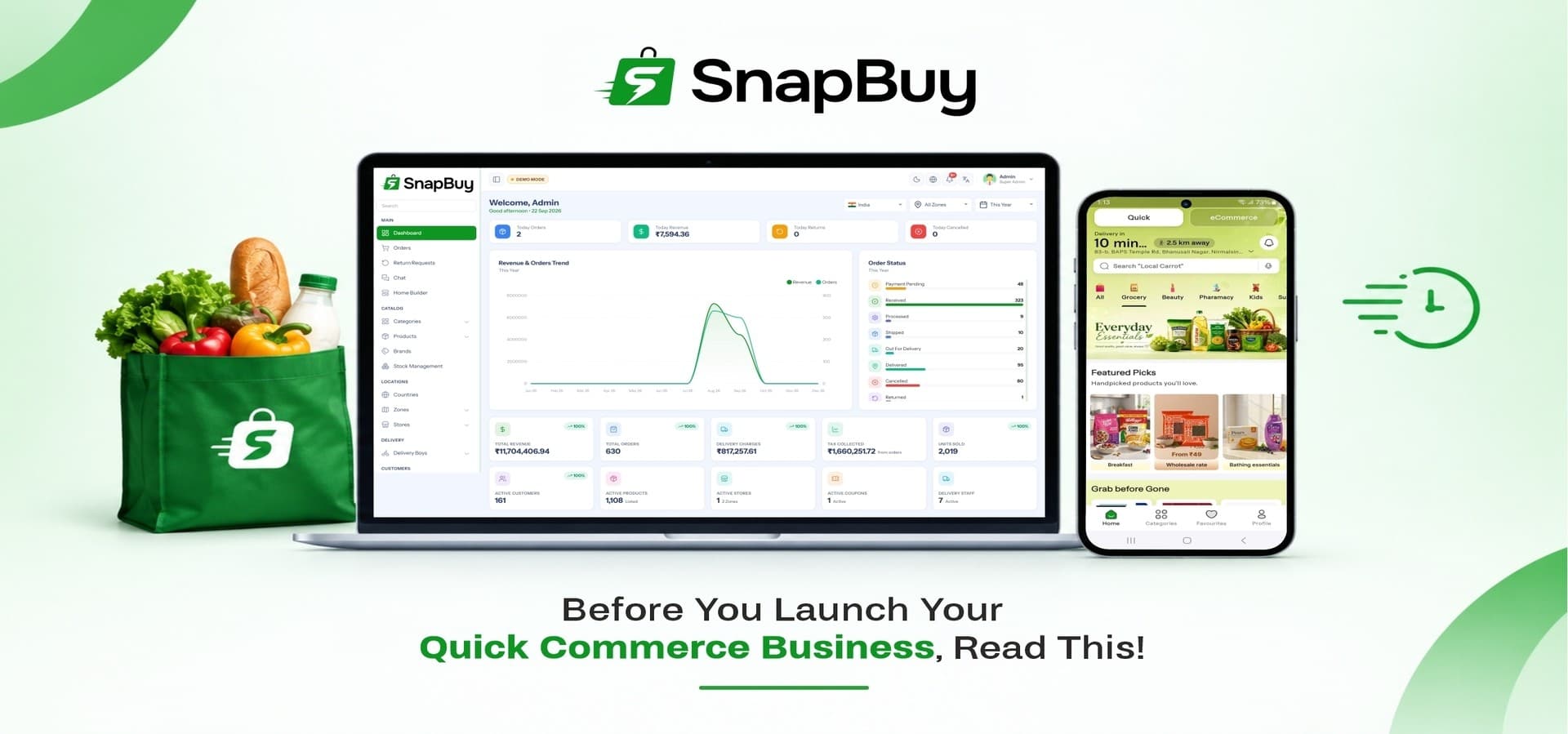
SnapBuy is a ready-made, multi-store hyperlocal ecommerce platform that combines quick commerce (fast, local, on-demand delivery) with traditional eCommerce (scheduled shopping and standard shipping) in a single ecosystem.
Instead of licensing or building two separate applications, an operator gets:
-
A customer-facing mobile app and web storefront
-
A delivery partner app for riders
-
A store panel for individual store managers
-
A centralized Laravel-based admin panel that ties all of it together
The platform is built on Flutter, Laravel, Next.js, MySQL, Firebase, and Node.js, with built-in integrations for Firebase Cloud Messaging, SMTP email, SMS gateways, and Google Gemini AI. That combination is what allows SnapBuy to function as a genuine ecommerce Management System rather than a simple storefront template, since order routing, delivery logistics, multi-store data, and customer engagement all sit under one technical roof.
Why Running Two Business Models on One Platform Matters
Grocery, pharmacy, and local retail businesses rarely fit neatly into "quick commerce" or "eCommerce" alone. A customer might want a 20-minute grocery delivery on a Tuesday and a scheduled bulk order shipped on a Friday. When those two experiences live in separate systems, inventory gets out of sync, reporting gets split, and support teams have to check two dashboards to answer one customer question.
SnapBuy addresses this directly: stores maintain one product catalog and one inventory pool, while customers simply choose how they want their order fulfilled.
Key Modules and Features
SnapBuy's feature set is organized around four groups: the shopping experience, order and delivery operations, store and catalog management, and business-wide controls.
Customer Shopping Experience
-
Quick & eCommerce Shopping in one app, so customers switch between instant local delivery and scheduled shopping without leaving the platform
-
Smart search with category filters, product variants, quick view, and recently viewed items
-
Guest checkout with a cart that automatically syncs once the customer logs in
-
Multiple payment options, including digital wallet, Cash on Delivery, and coupon or cashback redemption
-
Real-time order tracking with live delivery location and in-app support chat
-
Order cancellation, item-level returns, one-tap reordering, and downloadable invoices
Delivery and Fulfillment Operations
-
OTP-based delivery verification to reduce disputes and unauthorized handovers
-
A guided delivery workflow covering order acceptance, route navigation, confirmation, and return pickups
-
Self-service delivery boy registration with identity and bank detail submission
-
Earnings tracking, Cash on Delivery reconciliation, and wallet withdrawal requests for riders
-
A dedicated support chat channel between delivery staff and admins
Store and Catalog Management
-
Multi-store management from a single admin panel, including store hours, contact details, and map locations
-
Product management with variants, attributes, pricing, tax rules, and bulk Excel import and export
-
AI-generated product descriptions and SEO metadata using the built-in Gemini AI integration
-
Cross-sell and up-sell recommendations to lift average order value
-
Visual, no-code homepage builder for banners, featured sections, and promotional layout
Business-Wide Controls
-
Interactive, map-based delivery zone creation to prevent overlapping coverage areas
-
Flexible delivery pricing, including surge pricing, flat rates, and zone-based slabs
-
A live analytics dashboard filterable by country, zone, and time period
-
Role-based access control for unlimited staff accounts
-
Multi-country and multi-language support, including RTL layouts and Google Translate-assisted localization
Together, these modules are what make SnapBuy function as a complete ecommerce Marketplace Software rather than a single-purpose app: catalog, delivery, payments, and reporting are all connected rather than stitched together after the fact.
Who SnapBuy Is Built For
SnapBuy fits businesses that need either quick delivery, scheduled shopping, or both, without managing separate technical stacks:
-
Grocery and pharmacy operators who need fast, zone-based delivery alongside a standard online store
-
Multi-store retail chains consolidating several outlets under one customer app and one admin dashboard
-
Startups and agencies launching a commerce product without building the infrastructure from zero
-
Businesses expanding across borders, thanks to native multi-country, multi-currency, and multi-language support
Revenue Models Built Into the Platform
SnapBuy also ships with several monetization paths already built in, rather than requiring custom development to add them later:
-
Commission on every completed order across participating stores
-
Delivery, convenience, and surge fees
-
Recurring subscription plans for stores at different feature tiers
-
Paid promotions, sponsored listings, and homepage banner placements
-
In-app advertising and brand partnerships
-
Loyalty-driven repeat purchases through coupons, cashback, and referral rewards
Why WRTeam's SnapBuy
Buying a ready-made platform only pays off if the platform keeps working after launch. A few things set SnapBuy apart on that front:
-
Dual commerce from day one, quick delivery and standard eCommerce run on shared infrastructure instead of two apps competing for maintenance time
-
Built to scale, with multi-store, multi-branch, multi-country, and multi-currency support already in place rather than promised for a future version
-
Modern, maintained tech stack using Flutter, Laravel, Next.js, and Firebase, which keeps performance and security current as the platform grows
-
Documented setup path with demo apps, admin credentials, and installation documentation available before purchase
What to Look for Before You Choose a Platform
Not every Quick Commerce Software option on the market covers delivery zones, multi-store operations, and rider management equally well, and the gaps often don't show up until after launch. We've put together a complete feature checklist for evaluating a quick commerce and eCommerce platform that walks through exactly what to check before committing to any platform, including SnapBuy.
Where This Gets More Specific
The sections above cover SnapBuy at a platform level. A few areas benefit from a closer look depending on what you're trying to build.
Starting Small With One Neighborhood
Not every launch needs multi-country support on day one. Many operators start by running grocery or local retail delivery in a single area first, testing demand and delivery times before expanding zone coverage.
Managing Inventory Across Several Stores
Once a business grows past one location, keeping stock levels accurate across stores and matching delivery coverage to each store's service area becomes the main operational challenge.
Ready-Made Platform vs Custom Build
Some teams consider building a delivery script from scratch instead of licensing an existing platform. The real difference usually comes down to development time, ongoing maintenance, and how long it takes to reach a working product.
Keeping Riders and Deliveries on Schedule
Delivery speed is often the single biggest factor in customer retention for quick commerce. How dispatch, routing, and time tracking are handled has a direct effect on repeat orders.
Get Started With SnapBuy
SnapBuy gives you a single platform for both quick commerce and eCommerce, with multi-store and multi-country support built in from the start. Explore the full feature set and licensing options on the SnapBuy product page.