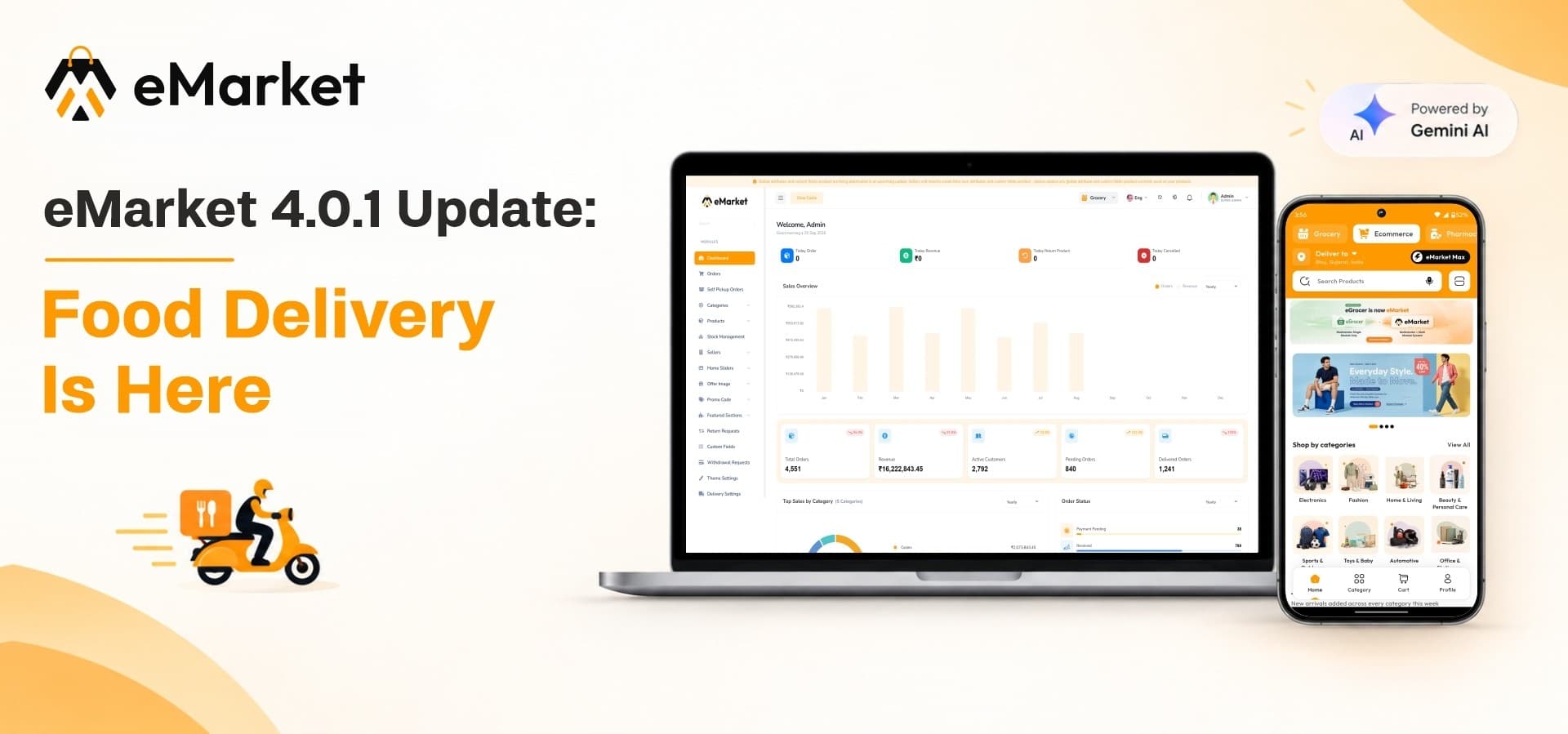
Running a delivery business used to mean choosing one lane. You picked groceries, medicines, or restaurant food, and every extra vertical meant another app, another backend and another admin panel to manage.
eMarket 4.0.1 removes that trade-off. The update adds a dedicated Food Delivery Module to a platform that already handles grocery, pharmacy, eCommerce and POS. If you are looking for a Multi-Module Delivery Platform that can grow into a full delivery business, this release gives you a much bigger field to play in.
This post covers what is new in 4.0.1, how the rest of the platform fits around it, and why eMarket is worth a serious look if you plan to launch a delivery or marketplace business.
1. Food Delivery Module: Restaurant Ordering, Built Into eMarket
.png)
Food delivery is not grocery delivery with a different label. Customers browse menus instead of shelves. They customize dishes instead of picking pack sizes. They search by what they feel like eating, not by product category. The 4.0.1 release treats food as its own vertical, with the pieces that behavior needs.
Restaurant menus
Each restaurant on your platform gets its own menu. Customers open a restaurant, see what it serves, and order directly from that menu. Restaurants control their own dishes, so your team does not have to key in every item by hand.
This matters for your marketplace model. A grocery listing and a restaurant menu are different things, and forcing restaurants into a product catalog built for packaged goods leads to clumsy listings and confused customers. A menu-first structure keeps the ordering experience familiar to anyone who has ever used a food app.
Dish addons and modifiers
Food orders are rarely "one item, no changes." A customer wants extra cheese, a larger size, less spice, or a side on the plate. Dish addons and modifiers let restaurants offer those choices right on the dish, so customers can build the order they actually want.
For restaurants, this means fewer phone calls and fewer misunderstood orders. For you as the operator, it means higher order values, because addons are one of the easiest ways to raise the basket size without adding a single new restaurant.
Cuisine filters
When a customer opens a food app, the first question is usually "what am I in the mood for?" Cuisine filters answer that quickly. Customers narrow the list to the type of food they want and skip the scrolling.
Filters also help smaller restaurants. A new kitchen with a strong cuisine focus can show up in front of the right customers without needing to outspend bigger names for attention.
Instant courier dispatch
Food does not wait. Once a restaurant accepts an order, delivery needs to start fast, because hot food loses quality with every minute it sits. Instant courier dispatch sends the order to your delivery partners without manual assignment steps in between.
The practical benefit is speed and less admin work. Your team is not sitting on a dispatch screen assigning every single order, and your customers see their food move sooner.
Why this module matters for your business
Food delivery is a habit category. People order meals several times a week, which gives you frequent repeat orders. When the same customer can also order groceries and medicines from the same app, you are no longer competing for one occasion. You are building a daily-use platform.
Adding the Food Delivery Module to eMarket lets you serve all of those occasions from one place, using the same customer base, the same delivery network and the same admin control. That is the real value of this release, and it is the reason it sits at the top of this post.
2. Quick Delivery: Configurable Fast Delivery Windows
The second addition in 4.0.1 is Quick Delivery. It lets your business define its own fast delivery windows, so you can offer ultra-fast, hyper-local fulfillment for everyday essentials and urgent orders.
The important word here is configurable. Delivery speed depends on your operations: how close your stores are, how many couriers you have, and how busy your area gets. eMarket does not lock you into a fixed promise. Instead, you set the windows in the admin panel based on what your business can actually deliver.
For example, a business with a dense network of nearby stores and a strong courier fleet might set up options like 15 minutes or 30 minutes. Those numbers are only examples. A business with a wider service area might configure longer windows, and that is perfectly fine. The point is that you choose the options, and you decide what you can honestly commit to.
This flexibility protects you from a common mistake in delivery businesses: promising a speed you cannot keep. When the windows match your real capacity, customers get what they were told, and your ratings stay healthy.
Quick Delivery works well for:
-
Everyday essentials that customers run out of and want right away
-
Urgent orders where speed matters more than saving a few rupees on delivery
-
Hyper-local zones where your stores or partners sit close to the customer
If you are building a Multi-Module Delivery Platform based business, this gives you a way to stand apart from slower competitors without overpromising.
3. Multi-Module Commerce Ecosystem: One Platform, One Backend, One Admin Panel
Many entrepreneurs start with a simple question: what can I actually build with eMarket? The answer is a lot more than a single-purpose app.
eMarket runs these modules from one unified platform:
-
Grocery: Sell fresh produce, packaged goods and daily needs from multiple stores.
-
Pharmacy Module: Offer medicines and health products in a dedicated vertical.
-
eCommerce Module: Sell general products such as electronics, fashion and home goods alongside your other categories.
-
Food Delivery Module: Now live in 4.0.1, with restaurant menus, addons, cuisine filters and instant dispatch.
-
POS: Handle in-store sales and keep them connected to the same system.
All of them share one backend and one admin panel. You do not maintain separate installations, separate logins or separate reports for each vertical. You launch the modules that fit your market and manage them from the same place.
This has a direct effect on cost and effort. Running five separate systems means five sets of updates, five sets of user accounts and five places where something can go wrong. A unified platform means one team, one dashboard and one customer account that works across every module.
It also gives you room to grow in stages. You might launch with groceries, add pharmacies once you have a customer base, and turn on food delivery when you are ready to bring restaurants on board. Because everything already lives on the same platform, each new vertical is an expansion, not a rebuild.
The WRTeam roadmap also lists a Parcel Delivery Module and a Ride Booking Module as planned additions. They are not part of 4.0.1 and are not live today, but they show the direction of the platform: more delivery and mobility verticals under the same roof over time.
4. Gemini AI: Faster Product Descriptions and SEO Metadata for Sellers
Anyone who has managed a large catalog knows the pain of writing descriptions. A seller with hundreds of products has hundreds of descriptions to write, and most sellers are running a shop, not a copywriting desk. The result is thin, copied or missing descriptions that hurt both sales and search visibility.
eMarket now includes built-in Google Gemini AI to help with exactly this. Sellers can use Gemini AI to auto-generate product descriptions and SEO metadata directly inside the platform.
Here is what that means in practice:
-
Faster listings. A seller adds a product and generates a description instead of writing one from scratch.
-
Better search visibility. SEO metadata is generated alongside the description, so products are easier for search engines to understand.
-
More consistent catalogs. When every product has a proper description, your marketplace looks more professional to customers.
-
Less work for your team. You spend less time chasing sellers for missing content.
For a marketplace operator, this is a quiet but valuable feature. The quality of your catalog is part of your brand. Every strong listing helps customers trust the platform, and every empty one makes it look unfinished. Gemini AI helps sellers fill that gap without extra tools or extra cost on your side to onboard them.
Sellers can still review and edit what Gemini AI generates, so the final wording stays in their hands.
5. Multi-Vendor Marketplace: Every Seller and Restaurant Runs Their Own Storefront
eMarket is built as a multi-vendor marketplace from the start. Multiple sellers or restaurants can list and manage their own products, menus and storefronts independently within the same platform.
That independence is what makes a marketplace scalable. If every listing had to go through your team, you would be the bottleneck. With eMarket, each vendor works from their own seller panel:
-
A grocery store manages its products and stock.
-
A pharmacy manages its own medicine catalog.
-
A restaurant manages its own menu, dishes and addons.
-
A general seller manages its own eCommerce listings.
You stay in control as the platform owner through the admin panel, while vendors handle their day-to-day work themselves. This is the model that lets a marketplace grow from ten vendors to hundreds without your workload growing at the same rate.
For customers, the experience is simple. They open one app, see many vendors, and order from whoever suits them. For vendors, the platform gives them a ready-made way to reach customers without building their own app. And for you, every new vendor adds more choice to the platform, which attracts more customers, which attracts more vendors.
If you have been searching for a Multi-Module Delivery Platform or app that supports more than one store, this structure is what to look for. A single-store template limits you to one shop. A multi-vendor platform lets you become the marketplace that many shops sell on.
6. Unified Order Management and Live Order Tracking
Once you have multiple vendors, multiple modules and multiple delivery types, order management can turn into chaos fast. eMarket keeps it in one place.
Every order, across every vendor and delivery type, is tracked from one control panel. Whether the order is a grocery basket, a prescription, a general product or a restaurant meal, you see it in the same system.
What you gain as the operator
-
One view of everything. You do not switch between dashboards to see what is happening across your business.
-
Faster problem solving. When a customer asks about an order, you find it quickly, whichever module it came from.
-
Cleaner operations. One workflow for orders means your team learns one process instead of five.
What your customers get
Customers get real-time tracking from dispatch to delivery. They can follow their order as it moves, which answers the question that fills support inboxes everywhere: "Where is my order?"
Live tracking matters most for food and urgent orders, where waiting without information is frustrating. When customers can see progress, they worry less, contact support less and trust the platform more. That trust shows up in repeat orders.
Together, unified order management and live tracking give both sides of the marketplace what they need: control for you and clarity for your customers.
Try eMarket 4.0.1 Live
The best way to judge a platform is to use it. Explore each part of eMarket through the live demos:
Walk through the admin panel to see how modules and orders are managed. Open the seller panel to see what your vendors will use. Check the delivery panel to see the courier side. Then open the web version to see the customer experience.
Ready to Launch Your Delivery Marketplace?
eMarket 4.0.1 turns a grocery and pharmacy platform into a broader delivery business. The Food Delivery Module brings restaurant menus, dish addons and modifiers, cuisine filters and instant courier dispatch. Quick Delivery lets you set the delivery windows your operations can support. Gemini AI helps sellers list products faster. And everything runs from one backend, one admin panel and one order management system.
If you want to launch a multi-vendor delivery marketplace without stitching together separate systems, eMarket is built for that goal.