Choosing a flutter quiz app to build your trivia, exam, or gamified learning platform on is not just a technical decision. It shapes how long players stay engaged, how many ways you can monetize the app, and how much work you'll need to do after launch just to keep content fresh. Before you commit to any source code or online quiz platform, it helps to know exactly which features separate a genuinely capable app from one that only looks complete in a demo video.
This guide breaks down the eight features worth checking for, whether you're comparing scripts, evaluating a SaaS quiz builder, or scoping out what a custom build should include. None of these are nice-to-have extras. Each one solves a specific problem that shows up once an app moves past a handful of test users, whether that's keeping a question bank fresh, giving players a reason to return daily, or turning engagement into actual revenue.
1. Multiple Quiz Formats and Zones
A single quiz style gets repetitive fast. Strong platforms give players several ways to engage instead of one repeated loop, which is what keeps a casual visitor coming back as a daily user.
Look for support across formats such as:
-
Standard quiz zones organized by category and difficulty
-
Daily quizzes that give players a reason to open the app every day
-
Math-focused and audio-based question types
-
Word-guessing and matching formats for variety
-
True/false rounds for quick, low-friction play
-
A "Fun & Learn" style mode that pairs short lessons with a quiz
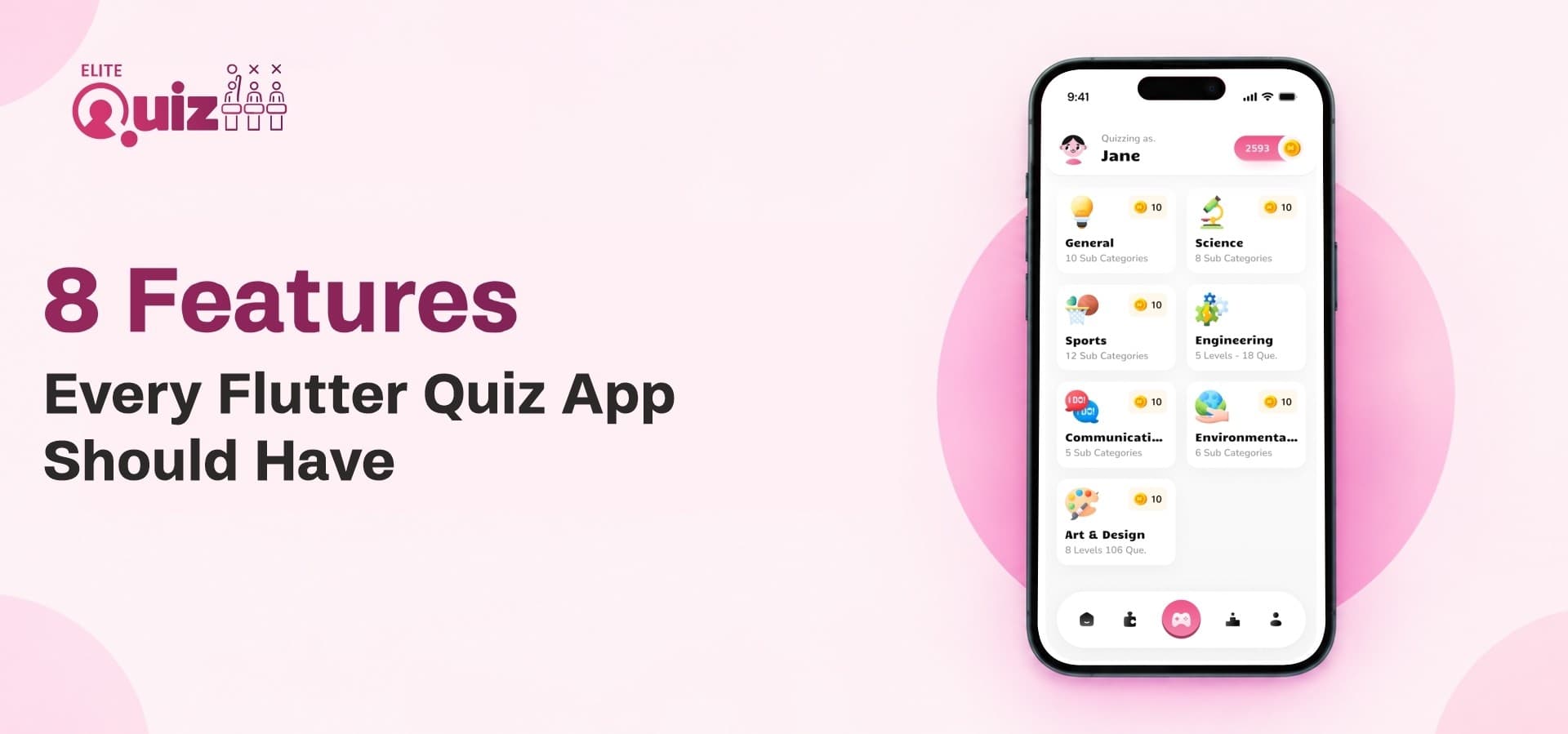
Elite Quiz covers this with nine distinct zones, including Quiz Zone, Daily Quiz, Math Quiz, Audio Questions, Guess The Word, Multi Match, True/False, Fun & Learn, and a dedicated Exam Mode, giving it a genuinely interactive quiz platform feel rather than a single-template app. Having this many formats available from launch also means you're not stuck offering only one type of content to every audience segment. A coaching institute can lean on Exam Mode and Math Quiz, while a trivia-focused community engages more with Daily Quiz and Guess The Word, all inside the same app.
2. Real-Time Multiplayer Battles
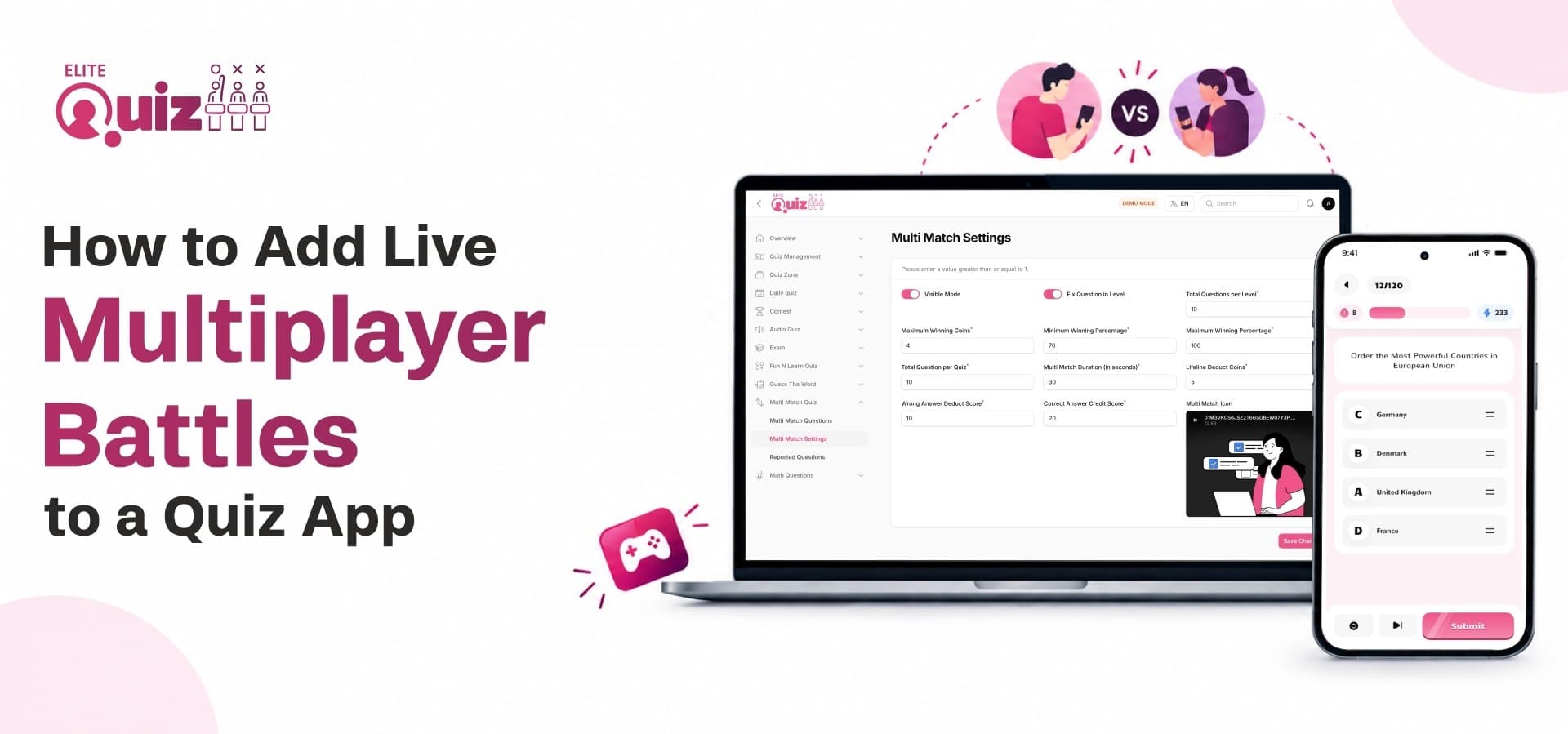
Trivia becomes a habit when it becomes social. A live quiz app needs the ability to let players compete against each other directly, not just against a static leaderboard, since head-to-head play is what drives repeat sessions and word-of-mouth growth.
At minimum, check for:
-
Random matchmaking against other online players
-
Direct one-on-one challenges between friends
-
Group battle formats for larger competitive rounds
-
Reward distribution tied to battle outcomes
Elite Quiz includes Random, Friend, and Group Battle modes built on Firebase for real-time syncing, so matches feel instant rather than laggy. This is also where paid entry battles and contests come in, turning competitive play into a direct revenue stream. Because the matchmaking and scoring run on infrastructure meant for live updates, players see results the moment a round ends instead of waiting on a delayed refresh, which matters a lot when the entire point of the feature is head-to-head competition.
3. AI-Powered Question Generation
Manually writing question banks is one of the slowest parts of running a quiz platform. A modern app should reduce that workload rather than leave every category to be typed out by hand.
A useful implementation should let admins:
-
Generate multiple-choice and true/false questions from a prompt or topic
-
Choose between AI providers rather than being locked to one
-
Review and edit generated content before it goes live
-
Produce new categories in minutes instead of days
Elite Quiz builds this in with support for both Gemini and OpenAI, so launching a new exam category or trivia topic doesn't require a content team sitting down to write hundreds of questions from scratch. This matters most in the first few months after launch, when the pressure to keep adding fresh categories is highest and a small team is usually handling content, marketing, and support all at once.
4. A Secure, Structured Examination System
If your audience includes coaching institutes, schools, or certification bodies, casual trivia features alone won't cut it. You need an exam mode built for accountability, not just entertainment.
This means:
-
Timed exams with a defined start and end
-
Access keys or codes to control who can join a specific exam
-
Ranking and result breakdowns after submission
-
Analytics that show performance by question, topic, or participant
Elite Quiz's Exam Mode covers all four, which is what makes it viable as a sellable product for test prep and institutional use rather than just a game layered on top of a question bank. That distinction matters commercially too, since institutes and training providers are usually willing to pay more for a controlled exam experience than a casual trivia session, provided the results and access controls hold up.
5. Flexible Question Bank Management
However good the front-end experience is, an admin still has to manage the content behind it. Weak question management tools become a bottleneck the moment your category list grows past a handful of topics.
Check that the admin panel supports:
-
Categories and subcategories, not just one flat list
-
Text, image, and audio-based question formats
-
Bulk import for adding large question sets at once
-
Moderation tools for reviewing flagged or reported questions
Elite Quiz's admin panel handles all of this from one dashboard, including bulk import for large banks and built-in moderation so content quality doesn't slip as the platform scales. Support for text, image, and audio formats also opens up question types that a plain text-only system can't handle, such as picture-based rounds or audio identification quizzes, without needing a separate tool.
6. Built-In Monetization Tools
A quiz app without monetization built into its architecture usually means bolting on payment logic later, which is slower and more error-prone than launching with it already in place.
Look for a combination of:
-
In-app purchases for coins or virtual currency
-
Premium categories locked behind a paywall
-
Paid entry fees for contests or battle modes
-
Advertising with an optional ad-free subscription tier
-
A referral program to reduce acquisition costs
Elite Quiz supports all five as native features rather than add-ons, giving operators several ways to generate revenue instead of relying on a single ad network. Spreading revenue across coins, subscriptions, contest fees, and advertising also means a dip in one stream, such as a temporary drop in ad rates, doesn't leave the whole business exposed.
7. Multi-Language and Global Reach
If your audience isn't limited to one language or region, the platform needs to support that from the admin side, not just through third-party translation plugins.
A properly built app should offer:
-
The ability to add new languages directly from the admin panel
-
RTL (right-to-left) layout support for applicable languages
-
Centralized translation management, without editing code per language
Elite Quiz includes multi-language and RTL support managed from the dashboard, which matters if you're positioning your app as an online trivia platform for a global player base rather than a single-market product. Handling this from the admin side also means adding a new language doesn't require a developer to touch the codebase, so expanding into a new market becomes a content task rather than a technical project.
8. Admin Control, Analytics, and Engagement Tools
The features players see are only half the picture. What happens behind the scenes determines how easy the platform is to actually run day to day.
Worth checking for:
-
Role-based access control so staff only see what they need
-
Leaderboards and badge or reward systems to drive engagement
-
A customizable push notification center for daily quizzes and contests
-
Centralized settings for monetization and ad management
Elite Quiz includes all of these, from role-based staff accounts to a notification center and reward system, so the operational side doesn't become an afterthought once the app is live. As a team grows past one person, role-based access in particular becomes less of a convenience and more of a necessity, since it prevents a support hire or content moderator from having the same level of access as an owner.
Where Elite Quiz Fits
Elite Quiz brings these eight features together in a single Flutter-based package with a Laravel admin panel, REST APIs, and a Next.js web platform, backed by Firebase for real-time battles. Instead of building a quiz format, a battle system, an exam engine, and a monetization layer separately, the pieces already work together out of the box, which is what turns a simple trivia idea into a platform you can actually run and grow.
The practical difference this makes shows up most in the first few months after launch. Rather than spending that time integrating a battle system with a payment gateway, or connecting an AI provider to a question bank that wasn't built for it, the groundwork is already in place. That leaves more time for the parts that actually determine whether the app grows, such as content strategy, marketing, and refining which quiz formats resonate with your specific audience.
If you're deciding between building from scratch and starting from ready-made source code, one of the biggest factors is how battles and real-time matchmaking get implemented, since that piece tends to be the most complex to build correctly and the easiest to get wrong. How to Add Live Multiplayer Battles to a Quiz App looks at exactly that, covering what goes into making head-to-head play feel instant rather than delayed.
Ready to see these features in action? Explore Elite Quiz on WRTeam Marketplace and check the live demo before you decide.