Riders want to know exactly where their cab is and what the trip will cost before they step outside. Fleet owners want the same clarity on the backend, because disputes over "where is my driver" and "why did the fare change" are two of the most common support tickets any ride-hailing operation deals with. A modern taxi booking app solves both problems at once, using live location data and a rules-based fare engine that removes the guesswork for everyone involved. eTaxi builds this directly into its Flutter customer app, Flutter driver app, and Laravel admin panel, so tracking and pricing work together instead of as two separate systems bolted onto each other.
This piece looks at how real-time tracking and fare calculation actually work inside eTaxi, why the two features depend on each other, and what that means for a business trying to run a reliable cab service across one city or several.
Why Real-Time Tracking Is the Backbone of Every Trip
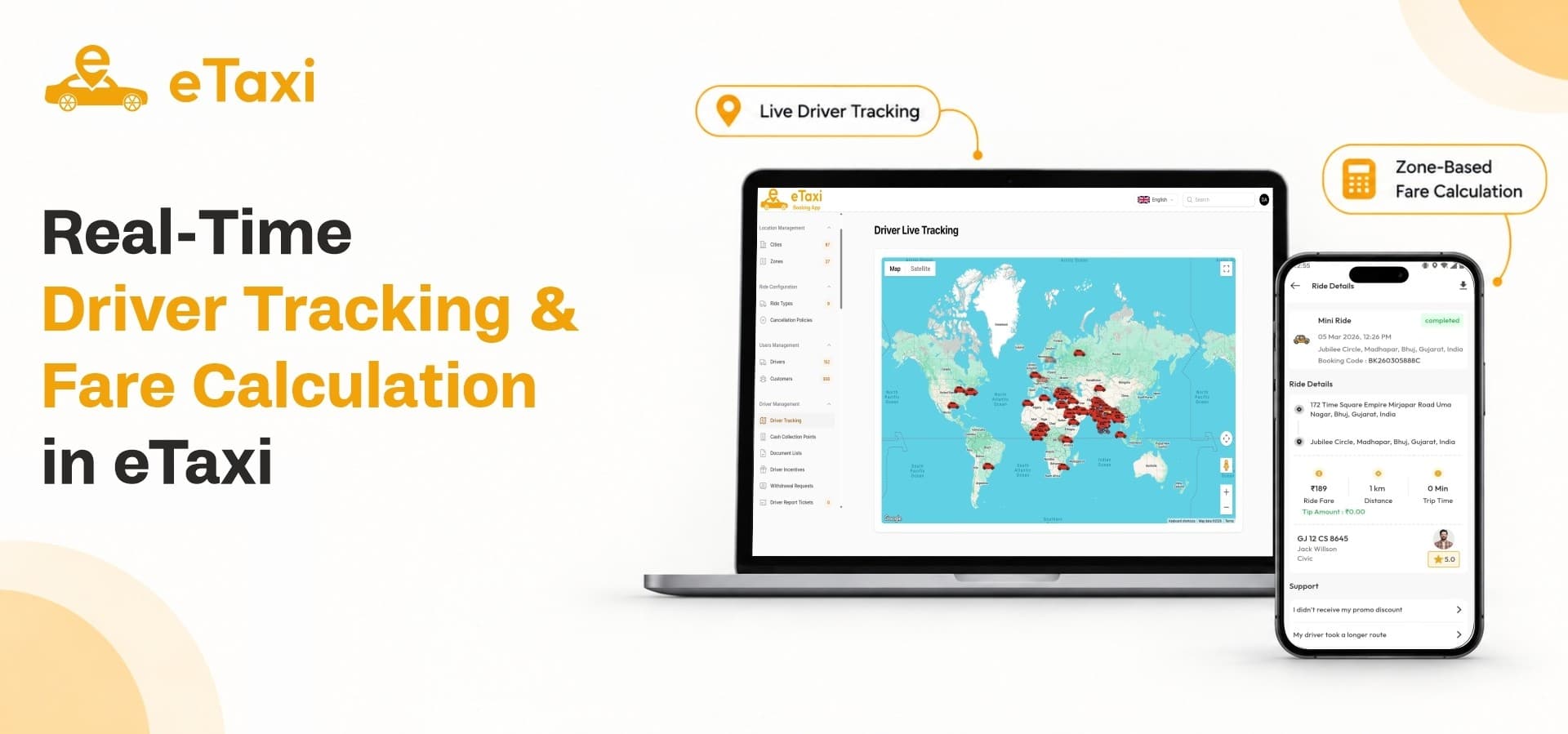
Tracking is not just a moving pin on a map. In a functioning ride booking app, live location data drives almost every decision that happens after a ride is requested: which driver gets matched, how the ETA is calculated, when the customer is notified of arrival, and how the trip is verified as complete. eTaxi uses WebSocket-based real-time updates paired with Google Maps, which means location changes push to the app instantly instead of the app having to repeatedly ask the server for an update.
How Live Location Updates Move Through the System
-
The driver's app reports position continuously while a trip is active or the driver is online and available.
-
eTaxi's fair driver matching engine uses that position, along with proximity and rating data, to assign incoming ride requests.
-
The customer app receives the driver's live route and an estimated arrival time before and during the trip.
-
The admin panel receives the same live feed, so support staff can see any active trip's exact location without contacting the driver directly.
This shared data stream is what allows eTaxi to support features like arrival confirmation, in-app navigation guidance for the driver, and live trip sharing, where a rider can send trip details to a friend or family member for safety.
What Live Tracking Solves for Fleet Owners
For a business running its own fleet, tracking is less about the map itself and more about accountability. Disputed pickup times, "the driver never showed up" complaints, and confusion over which driver was actually assigned to a trip all become far easier to resolve when every trip has a live, logged route. Ride management inside the admin panel gives operators that live oversight, along with searchable historical trip data for anything that needs to be reviewed after the fact.
How Fare Calculation Works Inside eTaxi
Accurate tracking only solves half the trust problem. The other half is making sure the fare shown to a rider actually reflects the trip they took, and that a driver's earnings reflect the work they did. eTaxi's fare system is built to be configured per city and per ride type rather than fixed globally, which matters because a flat fare structure rarely works once a platform expands beyond a single town.
Taxi management software built this way typically breaks fare calculation into a few components that stack together:
-
Base fare – a fixed starting charge for a ride category before distance is added
-
Distance-based charges – calculated from pickup to drop-off along the actual route driven
-
Waiting time charges – applied when a driver waits at pickup or during stops
-
Night charges – a separate rate applied automatically during set night hours
-
Surge multipliers – demand-based adjustments during peak hours, bad weather, or local events
Each of these can be set independently for every city and every vehicle type inside the admin panel, so a sedan in one zone can carry different base pricing than a bike in another, without any code changes.
Zone-Based Pricing Keeps Fares Fair
eTaxi's polygon-based zone system lets an operator define exact service boundaries and attach specific pricing rules to each one. This is particularly useful for businesses operating in cities where certain neighborhoods, airport routes, or outskirts justify different rates than the city center. Riders only ever see valid ride options and pricing for their actual location, which avoids the confusion of an app quoting a fare for a zone it doesn't actually serve.
Estimated Fares Before Booking Confirmation
Before a rider confirms a trip, eTaxi's nearby ride booking flow shows the estimated fare and arrival time for each available vehicle category, whether that's a bike, auto rickshaw, sedan, or premium option. Showing the number upfront, rather than after the trip ends, is one of the simplest ways to cut down on post-trip disputes and one-star reviews tied to "unexpected" charges. This is one of the details that separates a genuine cab booking app from a booking form with a map attached to it: the estimate has to be built from the same fare rules that generate the final receipt, not a rough guess shown just to get the customer to confirm.
From Estimate to Final Receipt: Keeping the Numbers Consistent
A fare estimate is only useful if the final charge matches it closely, barring legitimate changes like a longer route or extra waiting time. eTaxi closes that loop with a few connected features:
-
OTP-based trip start confirms the correct rider and driver are paired before the meter effectively starts
-
Active trip management tracks the live route so the final distance charged reflects the actual path driven, not a straight-line estimate
-
Trip receipt and invoice generation breaks the final charge into base fare, distance, taxes, and any discounts applied, with the option to download an official invoice from trip history
This kind of detailed, itemized breakdown matters more than it might seem. When a customer can see exactly why a fare came to a certain number, most disputes disappear before they start. When they can't, every trip becomes a potential support ticket.
Why This Matters More as a Fleet Scales
A single-car operation can get away with manual fare quotes and a driver checking a paper map. That approach breaks down fast once a business is coordinating multiple drivers across multiple neighborhoods. Any serious cab management software platform needs tracking and fare logic that scale together, because the two are directly connected: a fare engine that doesn't know which zone a trip started in cannot apply the right pricing rules, and a tracking system that isn't feeding live data into the admin panel leaves operators unable to explain a disputed trip after the fact.
This is also where tax handling fits in. eTaxi allows tax rules to be configured city by city, so the final fare shown to a rider already accounts for local tax requirements rather than needing a manual adjustment after the trip. For any operator managing several cities under one platform, that kind of built-in consistency saves a meaningful amount of manual reconciliation work every month.
What to Check Before Trusting a Platform's Tracking and Fare Claims
Not every taxi platform that advertises "real-time tracking" or "dynamic pricing" implements it the same way. A few practical checks separate a genuinely connected system from two features that just happen to sit in the same app:
-
Update frequency – does the driver's location push instantly, or does the app poll the server every few seconds and show a delayed position?
-
Fare-to-zone connection – does the pricing engine actually read the zone a trip starts in, or is fare configuration a single global setting applied everywhere?
-
Estimate-to-receipt consistency – does the estimated fare shown before booking use the same calculation logic as the final invoice, or are they generated by separate, disconnected processes?
-
Admin visibility – can support staff see a live route for any active trip directly in the admin panel, or do they have to call the driver to find out where a vehicle actually is?
-
Configurability without code – can new cities, zones, or ride types be added through the admin panel, or does every expansion require a developer to touch the fare logic?
Running through these questions before committing to a platform, whether it's a custom build or ready-made source code, tends to surface the gaps between marketing copy and what a system can actually do in production.
Built for Businesses That Want to Own the Platform
Fleet owners and transportation startups evaluating tracking and pricing tools are often comparing a fully custom build against ready-made source code. Custom development around live tracking and dynamic pricing is one of the more technically demanding parts of any mobility app to get right, and it typically adds significant time and cost before a single ride is ever booked. Buying a white label taxi app with this logic already built, tested, and documented lets a business skip that phase and move straight into configuring cities, zones, and fare rules for its own market.
This also matters for agencies building mobility solutions for local clients. Rather than developing a matching engine and fare calculator from scratch for every project, a ready-made online taxi booking system with real-time tracking and configurable pricing already in place can be adapted to a new city or vehicle mix far faster than a ground-up build.
It's worth noting where a platform like this sits relative to fully custom-built alternatives sometimes referred to as uber clone apps in search: the core difference isn't the concept, since ride-hailing platforms broadly share the same booking flow, but how much of the underlying logic, from zone-based fares to driver matching, arrives already built and configurable out of the box.
Where eTaxi Fits
eTaxi brings real-time tracking and configurable fare calculation together as one connected system rather than two separate add-ons. City and zone management, the fare engine, driver matching, and trip verification all run through the same Laravel admin panel and share the same live data feed from the Flutter driver and customer apps. For a fleet owner or startup evaluating options, that means less custom integration work and a shorter path from setup to an actual working ride-hailing service.
Get Started With eTaxi
Fleet owners, transportation startups, and agencies ready to launch a ride-hailing platform with real-time tracking and configurable fare calculation already built in can explore the full feature set on the eTaxi product page.