Quiz apps that only offer solo play tend to lose users fast. Someone answers ten questions alone, checks their score, and closes the app with no reason to come back that evening. Live multiplayer battles change that pattern. When players can challenge a friend, join a random opponent, or compete inside a group in real time, a quiz stops feeling like a static test and starts feeling like a game people return to daily.
This matters for anyone planning to launch an online quiz platform, whether the goal is trivia entertainment or exam preparation with a competitive edge. Building live battles from scratch means solving real-time sync, matchmaking, fairness, and reward logic all at once, which is why most founders look at ready-made quiz software instead of writing this layer themselves. This piece walks through what live multiplayer battles actually require, the battle formats worth supporting, and how the backend needs to be built so battles stay fair and fast.
Why Live Multiplayer Battles Matter for a Quiz App
A single-player quiz app competes only against itself. A quiz app with live battles competes against boredom, because there is always another opponent one tap away.
A few reasons live battles move the needle for retention and revenue:
-
Session frequency goes up. Players check in multiple times a day to defend a rank or accept a challenge, not just once to finish a daily quiz.
-
Social pressure drives return visits. Losing to a friend creates a natural reason to open the app again for a rematch.
-
Battles create a monetizable moment. Entry fees, coin wagers, and premium battle modes turn competitive play into a direct revenue stream rather than relying only on ads.
-
Live play differentiates the product. Plenty of quiz apps offer static question banks. Fewer offer a genuinely live quiz app experience where two or more people answer the same questions at the same time and see results instantly.
None of this works, though, if the live layer is slow, unfair, or unstable. That is where the technical decisions below come in.
Battle Formats a Quiz App Should Support
Not every player wants the same kind of competition. A well-rounded interactive quiz platform usually supports at least three battle formats, each solving a different use case.
Random Battles
Random battles match a player with any available opponent, usually within the same category or difficulty tier. This format is what keeps the app playable at any hour, because it does not depend on the player knowing anyone else who is online. For a new platform still building its user base, random matchmaking is often the format that gets the most use early on, since it removes the "nobody to play with" barrier entirely.
Friend Battles
Friend battles let a player invite someone specific, usually through a shareable code, link, or in-app friend list. This is the format that drives social sharing and word-of-mouth growth, since inviting a friend to play is a natural, low-friction action. It also tends to produce the highest engagement per match, because players care more about beating someone they know than beating a stranger.
Group Battles
Group battles bring three or more players into the same live round, which suits trivia nights, classroom competitions, or team-based corporate quizzes. This format works well for community-building use cases, where the goal is not just individual competition but a shared, scheduled event that a group experiences together.
Supporting all three formats, rather than picking just one, is what lets a platform serve both casual solo users and organized group use cases without needing separate apps.
How Real-Time Battles Actually Work Behind the Scenes
The gameplay experience looks simple from the player's side. Two people answer the same question, a timer counts down, and the winner is shown. Underneath, that simplicity depends on infrastructure built specifically for real-time sync.
A few technical pieces have to work together:
-
Real-time data sync. Every answer, timer tick, and score update needs to reach both players within milliseconds, not seconds. This is typically handled through a real-time database layer such as Firebase Cloud Firestore, which pushes updates to connected devices as soon as they happen rather than requiring the app to repeatedly poll a server.
-
Fair matchmaking logic. Matching players by category, difficulty, or skill level keeps battles competitive instead of one-sided, which matters for retention. A mismatched battle where one player answers far faster or knows the category cold is a quick way to lose the losing player's interest.
-
Synchronized question delivery. Both players need to see the exact same question at the exact same moment, with server-controlled timing so neither side can exploit a faster connection to see the question first.
-
Instant result calculation. Once both players answer or the timer expires, the winner needs to be determined and displayed immediately, along with any coins, rewards, or ranking changes earned from the match.
This is the layer that separates a genuinely live experience from a quiz app that only simulates competition with delayed leaderboard updates. Founders evaluating any flutter quiz app source code should specifically check whether battles run on true real-time infrastructure or whether "multiplayer" just means asynchronous score comparison after the fact.
Configuring Battles From the Admin Side
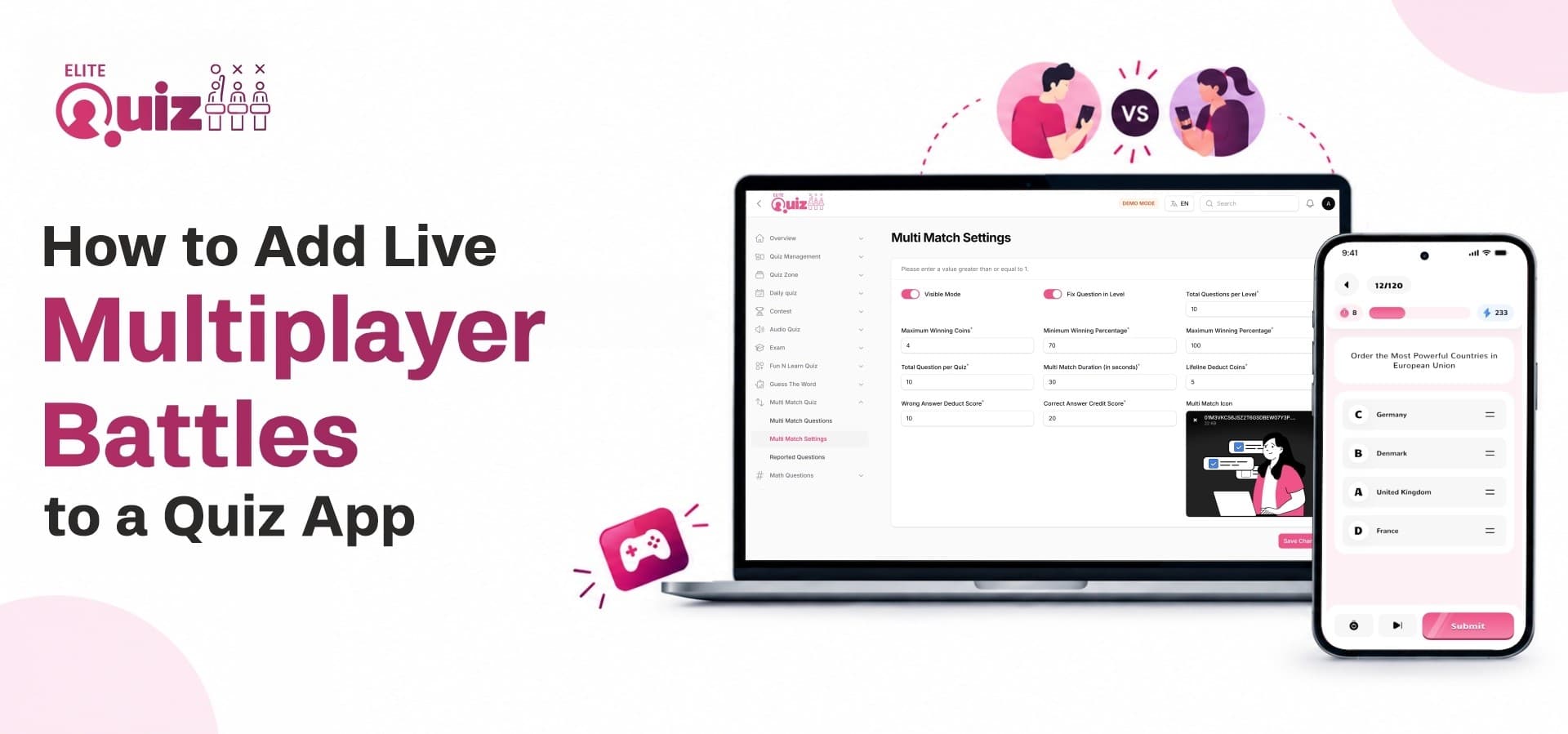
Live battles are not just a player-facing feature. The admin panel behind the app needs its own set of controls, because someone has to configure what a battle actually costs, rewards, and how matches are formed.
A capable admin setup for battle and contest management typically includes:
-
Entry fee settings for premium or paid battle modes, so certain battles can require a coin buy-in while others stay free to play.
-
Reward distribution rules that define what winners earn, whether that is coins, badges, or ranking points.
-
Matchmaking configuration to control how players are grouped, by category, difficulty, or other criteria the platform owner sets.
-
Category and question bank management feed into battles, so admins can decide which subjects are available for live competition versus solo play only.
Without this admin-side control, a platform owner has no way to run promotions, adjust difficulty for new user cohorts, or launch paid contests around specific events. This configuration layer is what turns live battles from a fixed feature into an ongoing tool the business can actually manage.
Monetizing Battle Modes
Live battles are not only an engagement feature. They are also one of the more direct ways a quiz app generates revenue, because competition creates a natural willingness to spend.
Common monetization paths built around battles include:
-
Coin-based entry fees for premium battle rounds, where players spend in-app currency purchased through the app store to enter higher-stakes matches.
-
Scheduled paid contests, where an entry fee gives access to a time-limited competitive event with a prize pool or ranked reward.
-
Ad-supported casual battles, where free random battles are monetized through banner, interstitial, or rewarded video ads instead of entry fees.
Running both free and paid battle formats side by side lets a platform serve casual players while still capturing revenue from the more competitive segment willing to pay for higher-stakes matches.
Common Mistakes to Avoid When Adding Live Battles
A few recurring issues show up when live battles are added to a quiz app without enough planning around fairness and load.
-
Ignoring latency differences between players. If the system does not account for network delay, a player with a faster connection can gain an unfair edge on timing, which frustrates the player on the slower connection even when both answers are correct.
-
Treating matchmaking as random with no filters. Pairing a brand-new player against someone with hundreds of wins rarely ends well for the newcomer. Category and skill-based filters, even simple ones, keep early matches close enough to stay fun.
-
Skipping reconnection handling. Mobile connections drop. A battle system that ends the match the instant a player's connection blips, instead of allowing a short reconnection window, loses matches and goodwill over something entirely outside the player's control.
-
Launching paid battles before free ones are proven. Introducing entry fees before the free battle experience feels smooth and fair tends to suppress adoption. Getting the free format right first builds enough trust for players to spend on premium modes later.
-
Underestimating admin workload. Battles that cannot be paused, rescheduled, or adjusted from the admin panel put every fix in a developer's hands. Admin-side flexibility over categories, fees, and rewards is what keeps a live battle system manageable long after launch.
Getting these details right up front tends to matter more for retention than the specific battle formats offered, since a laggy or unfair match will push a player away faster than a missing feature ever would.
Testing Live Battles Before Launch
Before opening battles to real users, it helps to run through a short checklist to confirm the real-time layer holds up under normal conditions:
-
Simulate simultaneous answers from two test devices to confirm both scores update instantly and match, with no lag between the two screens.
-
Test on a throttled connection to see how the app behaves when one player's network is noticeably slower than the other's.
-
Force a mid-battle disconnect on one device to check whether the reconnection window works as expected, rather than immediately forfeiting the match.
-
Run a Group Battle with the maximum configured player count to confirm the real-time sync layer holds up as participant numbers grow, not just in one-on-one matches.
-
Verify reward and coin deduction accuracy after a batch of test matches, since entry fees and prize payouts need to reconcile correctly before real money or purchased coins are involved.
Running through this list before launch catches most of the timing and fairness issues that are far harder to diagnose once live players are already mid-match.
Where Elite Quiz Fits
Elite Quiz builds live multiplayer battles as a core feature rather than an add-on. The app supports Random, Friend, and Group Battle formats out of the box, running on Firebase for real-time sync so matches stay fast and fair without any custom backend work.
On the admin side, the Battle & Contest Configuration panel gives platform owners direct control over entry fees, reward distribution, and matchmaking rules, so battles can be tuned as the user base grows. Paid contests and premium battle modes sit alongside the free-to-play formats, giving the platform multiple ways to earn from competitive play, in addition to ads and coin-based premium content.
Because the entire battle system, gameplay, matchmaking, and admin configuration, ships as part of the source code, launching a genuinely competitive online trivia platform does not require building real-time infrastructure from zero.
Ready to add live multiplayer battles to your quiz platform?
Explore Elite Quiz's Random, Friend, and Group Battle system, along with full admin control over entry fees, rewards, and matchmaking, at Elite Quiz on WRTeam Marketplace.