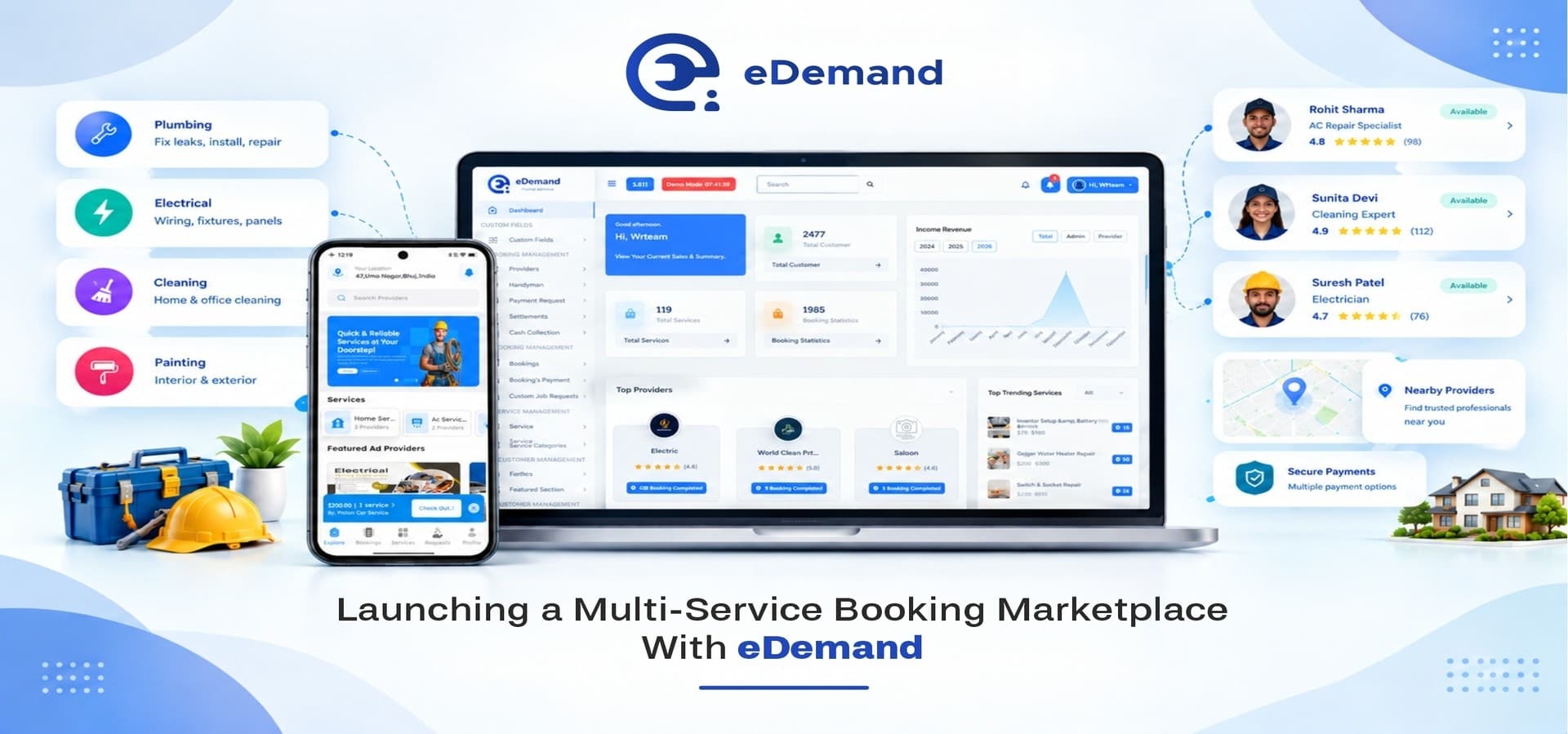
Anyone researching an on-demand home service app eventually hits the same wall: booking logic, provider tools, and payment flows take months to build correctly, and most of that work has nothing to do with what makes a service brand different. eDemand exists to remove that wall. It's a ready-to-launch platform for running a multi-vendor handyman and home service marketplace, built so the technical foundation is already solved and the business can focus on providers, categories, and growth.
This post walks through what eDemand actually includes, who it fits, and how the platform turns into a revenue-generating business rather than just an app.
What Is eDemand
eDemand is a multi-vendor on-demand service platform for handyman and home service businesses. It pairs a Customer app and a Provider app, both built in Flutter, with a Next.js website and a CodeIgniter 4 and MySQL backend. That combination means the same platform runs a near-native mobile experience on Android and iOS while keeping the backend light enough to host on shared or cloud servers.
The people who typically look at a platform like this fall into three groups:
-
Entrepreneurs launching a new handyman or home service brand
-
Agencies building service booking platforms for clients
-
Developers searching for a ready on-demand app template instead of custom development
For all three, the appeal is the same: a tested, white-label codebase they can brand and publish, instead of rebuilding provider management, scheduling, and payments from the ground up. It's a common enough need that comparisons to platforms like Gojek clone script builds come up often, though eDemand is scoped specifically around service bookings rather than a broad super-app of unrelated verticals.
Core Modules and Features
Provider-Driven Marketplace
Providers manage their own services, pricing, profiles, and working hours directly. That shifts day-to-day listing management off the admin's plate entirely. Whether ten providers join in the first month or ten thousand join over a year, the workload for the platform owner does not scale up in proportion.
Geo-Based Provider Discovery
Nearby providers surface automatically through Google Maps-based geolocation. There is no manual setup of service zones by country, state, or city, and customers see relevant providers without extra configuration on the admin side.
Multiple Services in One Booking
Customers can bundle several services from the same provider into a single order rather than booking each one separately. This lifts average order value for providers and makes the checkout flow noticeably smoother for customers juggling more than one task.
Smart Timeslot Suggestions
The platform calculates expected service duration and recommends open timeslots based on real provider availability. Customers book with more confidence, and providers skip the manual back-and-forth of confirming schedules by hand.
Custom Job Requests and Bidding
Not every job fits a standard listing. Customers can post a job description with photos, and providers respond with competitive bids. This opens the marketplace to non-standard requests and gives the platform an additional path to bookings beyond fixed-price listings.
Flexible Commission and Subscription Model
Admins can run commission-based pricing, provider subscriptions, or both at once from a single dashboard. That flexibility matters for anyone comparing this to a typical handyman app like uber, where the revenue model is usually locked to commission only.
Who eDemand Is Built For
-
New home service brands that want to launch a booking app without an in-house engineering team
-
Agencies delivering white-label service platforms to multiple clients under different brand names
-
Existing local service businesses moving from phone bookings and spreadsheets to a structured digital platform
-
Developers and small tech teams who want a production-ready base for on-demand handyman app development instead of starting from a blank repository
Why WRTeam's eDemand
Building a multi-vendor on-demand booking system in-house typically means months of development and a budget that runs into tens of thousands of dollars, with the biggest risk usually falling on getting the booking, provider, and payment logic right the first time. eDemand replaces that risk with a codebase that is already tested and running in production elsewhere.
A few things separate it from a generic delivery script repurposed for services:
-
Purpose-built for bookings, not deliveries. Timeslots, job bidding, and multi-service orders are designed around service work specifically, not adapted from a food or parcel delivery flow.
-
Full stack included. Customer app, provider app, admin panel, and website all ship together instead of being sold as separate add-ons.
-
Ready-to-Launch configuration. Extended license buyers get backend deployment and domain server setup handled by WRTeam's engineering support desk, along with three months of maintenance support after launch.
-
Continuity. Lifetime license validity with free updates means the platform keeps pace with new payment gateways, SMS providers, and Firebase services over time rather than going stale.
For anyone comparing this against custom uber for handyman app development, the practical difference comes down to time to market. A custom build starts from zero. eDemand starts from a working platform that just needs branding, provider onboarding, and configuration.
What to Look for Before You Choose a Platform
Not every on-demand service script is built the same way, and the gap usually shows up in things that are hard to spot from a feature list alone: how well providers can manage their own listings, how commission structures are handled, and how much of the setup is actually done for you versus left as a DIY project.
Going Deeper Into How eDemand Works
The sections above cover eDemand at a high level. A few areas are worth understanding in more depth if a multi-service booking marketplace is genuinely on the roadmap.
Running Bookings Without Building a Super-App
Some businesses assume they need to build a broad, all-in-one super-app to compete on convenience. In practice, a focused on demand home service app covering one or two service categories can launch faster, prove the model, and expand later without the overhead of maintaining unrelated verticals from day one.
How Providers Manage Their Own Business Inside the Platform
Provider tools determine how much admin work a marketplace actually creates. Availability, pricing, service descriptions, and job responses are all handled by the provider directly, which matters most once a marketplace grows past a handful of providers and manual oversight stops being realistic.
Choosing Between Single-Category and Multi-Category Platforms
Not every service business needs multiple categories from launch. Understanding when a single-service booking app is enough, and when a multi-category structure like eDemand's becomes necessary, is a decision worth making early rather than after the first migration.
Turning Commission and Subscription Tools Into Actual Revenue
Having commission and subscription options available is different from using them well. Structuring pricing tiers, setting commission rates by category, and deciding when to introduce provider subscriptions all affect how quickly a marketplace becomes profitable.
Get Started With eDemand
A multi-service booking marketplace does not need to start as a multi-year engineering project. eDemand provides the booking logic, provider tools, and payment infrastructure already built and tested, ready to be branded and launched.