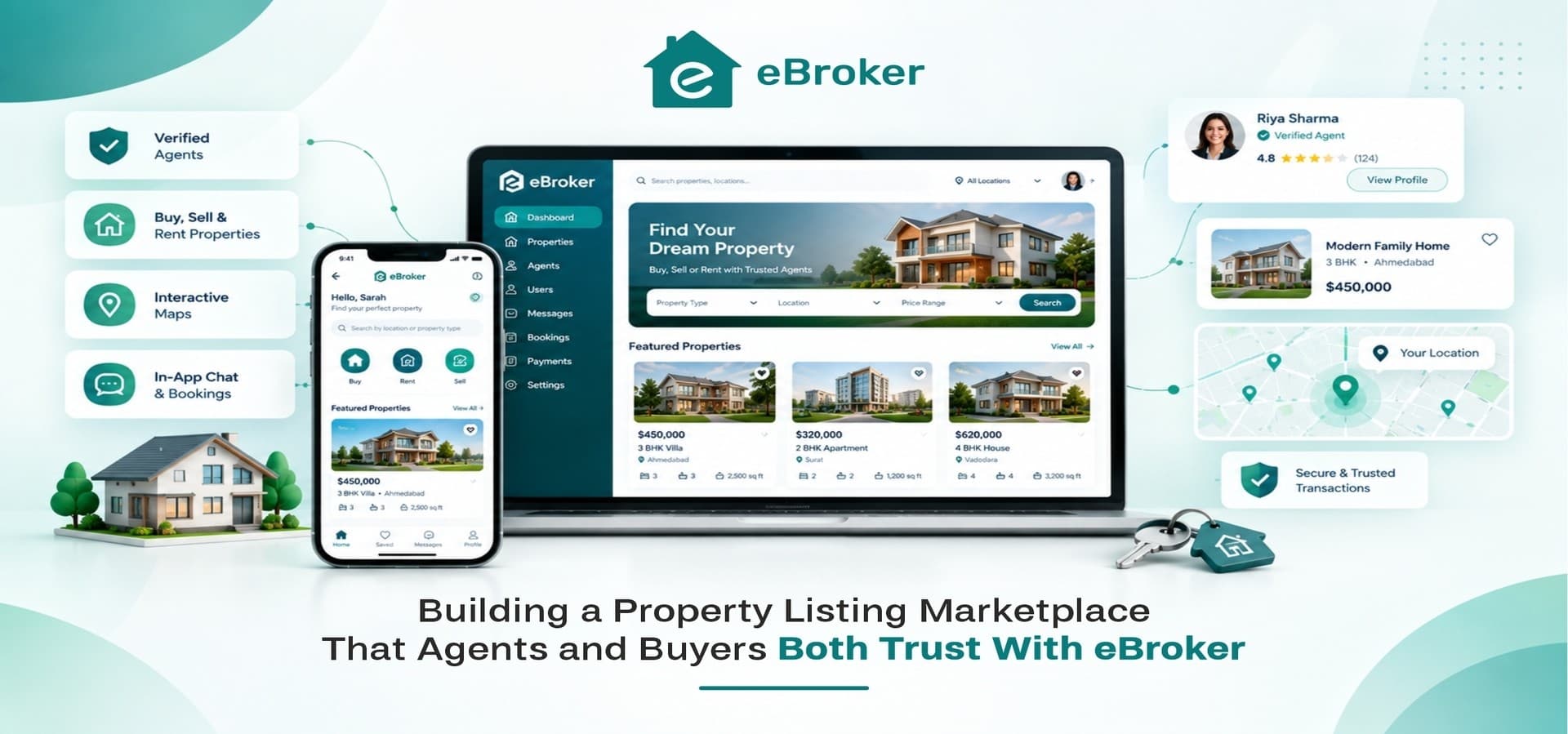
Property portals fail for one of two reasons. Either buyers stop trusting the listings because half of them are outdated or fake, or agents stop posting because the platform gives them no real way to stand out. A property marketplace only works long term when both sides feel the system is fair, current, and worth their time. That's the gap eBroker is built to close.
eBroker is real estate software that combines a Flutter mobile app, a Next.js web frontend, and a Laravel admin panel into one connected platform for buying, selling, and renting property. Instead of spending months building this infrastructure from scratch, you get a working foundation you can brand, configure, and launch, with the verification tools, communication features, and monetization built in from day one.
Whether you're launching a brand new listing marketplace or replacing an outdated one, the underlying challenge is the same: buyers need to believe what they're looking at is real and current, and agents need a reason to keep posting instead of drifting back to whatever portal already has the most traffic. Getting both of those right at once is what actually determines whether a property platform survives past its first year.
What Is an eBroker?
eBroker is a production-ready property management software platform designed for property marketplace startups, real estate agencies, independent brokers, and regional listing platforms. It runs on a proven stack: Flutter for the mobile apps, Next.js and Tailwind CSS for the web experience, Laravel and MySQL for the backend, and Firebase for real-time features like chat and notifications.
What sets eBroker apart from a basic listing script is that it treats two very different user types as first-class citizens on the same platform:
-
Regular users, who can browse, save, and post individual properties
-
Verified agents, who get branded profiles, subscription tiers, and greater visibility for their listings
This dual structure means the platform can grow organically. Users who post a few properties and see results can apply to become agents, expanding your broker network without you manually recruiting each one.
That growth path matters more than it first appears. Most property platforms either stay small because they never attract professional agents, or they lose casual users because the system is built only for agencies. eBroker is designed to hold both groups at once, so the marketplace can start with a handful of individual sellers and grow into something agencies rely on, without needing a platform migration in between.
Core Modules That Make eBroker a Working Real Estate Business
Every module in eBroker maps to something an agent, a buyer, or an admin actually needs, not a feature added just to pad a spec sheet.
Agent Verification and Listing Management
Trust on a property portal starts with knowing who's actually behind a listing. eBroker's admin panel lets you review and approve agent applications before they go live, so buyers can tell the difference between a casual seller and a verified professional. Agents who clear this process get a branded profile, structured listing tools, and package-based visibility, which keeps the marketplace organized as it scales past a handful of listings.
AI-Powered Listing Creation and SEO
Writing a strong property description and getting it to rank on Google are two separate skills, and most agents have time for neither. eBroker includes AI-assisted description writing and AI-suggested SEO metadata directly inside the listing flow, so a property gets posted faster and shows up in more searches without extra manual work from the agent or your admin team.
Interactive Maps and Location-Based Discovery
Buyers rarely search by address first, they search by area. eBroker's integrated map, powered by Google Maps or OpenStreetMap, lets users browse listings geographically and filters the feed based on location relevance, so someone looking in one neighborhood sees the most contextually relevant properties first.
360° Image and Video Galleries
For a property booking app, the gap between “interested” and “inquiry” often comes down to how effectively a listing is presented. eBroker enhances the property discovery experience with 360° image uploads, video tours, and detailed amenity information, giving buyers and renters a comprehensive view of each property. These rich visual features help users explore properties remotely, understand the space and its facilities, and shortlist their preferred options without needing to visit the property first.
Buyer-Agent Chat and Appointment Booking
Once a buyer is interested, speed matters. eBroker includes in-app chat between buyers and agents plus a built-in appointment booking system, so a viewing can be scheduled without either side leaving the platform or losing the conversation thread to a phone call that never gets logged anywhere. This keeps every lead trackable from first message to signed deal.
Comprehensive Admin Control
Behind all of this sits an admin panel that manages users, agents, listings, subscription packages, ad banners, SEO settings, articles, homepage layout, and payment gateway configuration. As a property management app, eBroker is meant to run without anyone touching raw code, which matters once your team includes people who aren't developers.
Who eBroker Is Built For
eBroker fits a range of businesses that all share the same underlying need: a structured way to connect property listings with serious buyers.
-
Property marketplace startups launching a new listing platform without building the tech stack from zero
-
Real estate agencies that want their own branded app instead of relying entirely on third-party portals
-
Independent brokers who need professional-grade tools without enterprise software pricing
-
Regional listing platforms focused on a specific city, state, or property type
Each of these groups tends to weigh the platform differently. A startup usually cares most about time to launch, an agency cares about branding control, and an independent broker cares about how quickly a lead turns into a conversation. eBroker's feature set is broad enough to serve all three without forcing any of them into workarounds.
How eBroker Turns Listings Into Revenue
A property portal only stays viable if it earns from more than one source, and eBroker is built around several income streams working at the same time.
-
Pay-as-you-go listing fees. Casual sellers pay per property posted, which lowers the barrier to entry while still generating transaction revenue from every listing.
-
Agent subscription packages. Professional agents subscribe to tiered plans for higher posting limits and stronger visibility, creating predictable recurring revenue.
-
Featured and promoted listings. Agents and owners can pay to push a listing to the top of search results and category feeds.
-
Ad banner revenue. The admin panel includes full ad management, so you can sell display space to mortgage providers, interior designers, and other businesses trying to reach property seekers.
Balancing a low-friction entry fee against a stronger recurring subscription tends to be the detail that determines how sustainable a listing marketplace actually is once the initial user base settles in. Platforms that rely on a single revenue stream tend to stall the moment that one channel slows down, which is why running several models side by side holds up better across different market conditions.
What to Look For Before Choosing a Property Platform
Not every real estate script on the market handles verification, discovery, and monetization equally well, and the differences usually aren't obvious until you're already committed to one. Before picking a platform, it helps to know which features actually separate a genuinely usable one from a generic listing script. We've put together the complete feature checklist for evaluating real estate management software.
eBroker vs. Building on a Generic Directory Script
Plenty of open-source directory scripts can technically list properties, but most weren't designed with real estate specifically in mind. They tend to lack agent verification tiers, structured lead capture, location-aware discovery, and built-in monetization beyond basic classified fees. Adapting a generic script to handle all of that usually means custom development work before launch, and ongoing maintenance after it.
The cost comparison rarely favors the generic route either. What looks like savings on the initial script price is often offset by developer hours spent adding agent tiers, appointment scheduling, and map-based discovery after the fact, features that already ship with eBroker on day one.
Why Choose WRTeam's eBroker
WRTeam has built and maintained eBroker as a complete, supported product rather than a one-time script sale. That includes lifetime license validity with free updates, ongoing technical support, and, on the extended license, free setup assistance with backend deployment and domain configuration so you can launch faster without handling server work yourself. As one of the best real estate apps available as ready-to-deploy source code, eBroker gets continued updates rather than being left static after purchase.
That ongoing support is often the difference buyers overlook when comparing source code products. A platform that stops receiving updates a year after release will eventually fall behind on security, device compatibility, and new features competitors are shipping. eBroker's update history and support structure are built around the assumption that you're running a real business on top of it, not just a one-off project.
Ready to Launch Your Own Property Marketplace?
eBroker gives you the verification tools, discovery features, and monetization structure to run a real estate platform buyers and agents both trust.
Explore eBroker on WRTeam Marketplace to see the full feature set and licensing options.