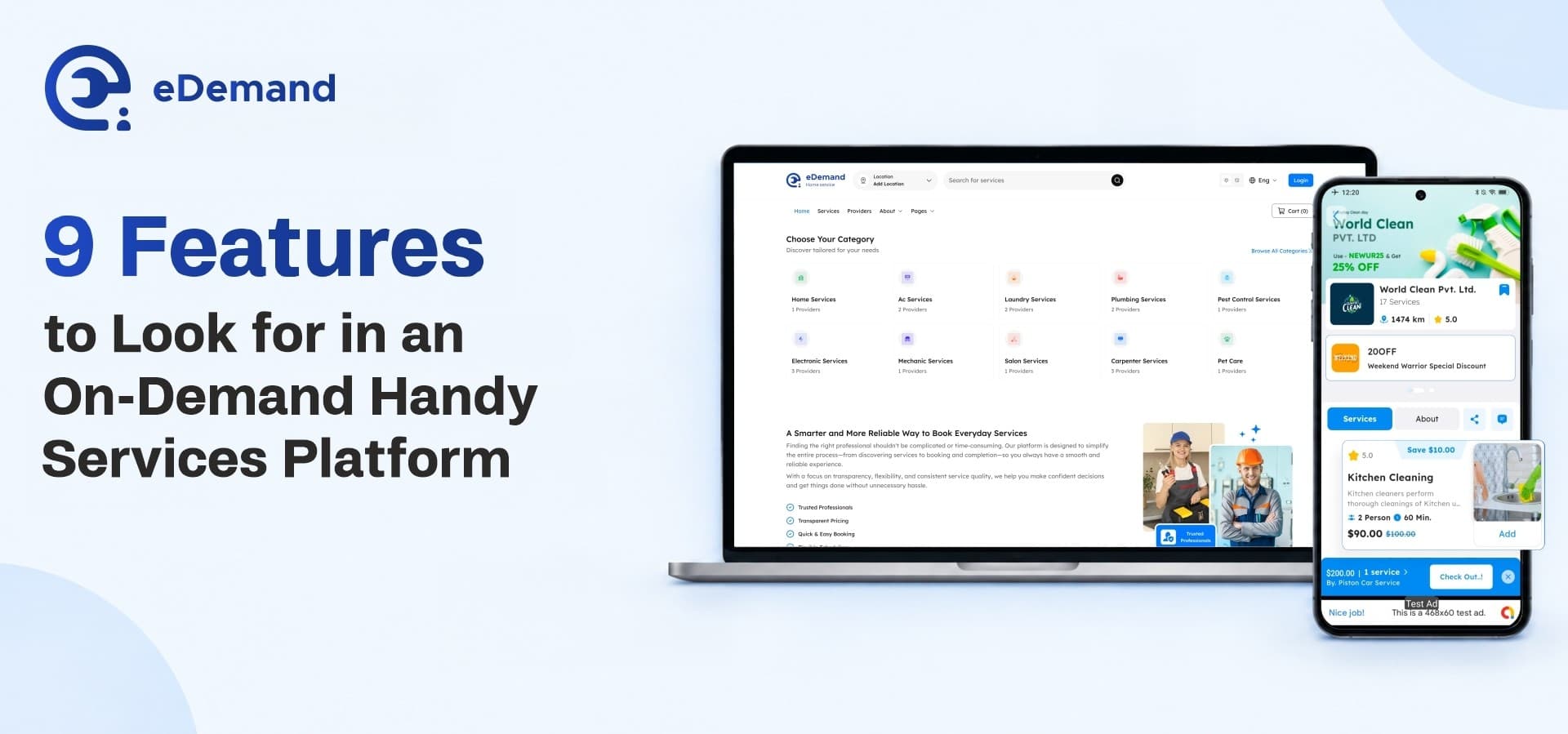
Home repairs, cleaning, and small installation jobs used to mean flipping through local directories or asking a neighbor for a recommendation. That search now happens inside an app, and the businesses that win are the ones running a properly built on demand home service app instead of a patched-together booking form on a website. Customers expect the same instant, trackable experience they already get from ride-hailing and food delivery apps, and a platform that falls short of that expectation loses bookings before a provider ever gets involved.
If you're comparing platforms to launch your own handyman or home service brand, it helps to know exactly which capabilities separate a real booking system from a glorified contact form. Many entrepreneurs start by researching custom development, only to find that a booking engine, provider tools, payment flows, and an admin dashboard together take months to build and test properly. A ready platform skips that timeline, but only if it actually includes the features a service marketplace needs on day one.
Below are the nine features worth checking before you commit to any on-demand handyman app development partner or ready-made script. Each one covers a real gap that shows up once a marketplace has more than a handful of providers and bookings running through it.
1. Provider Self-Service Management
A platform that makes admins manually add every provider, service, and price update does not scale. Look for a system where providers manage their own:
-
Service listings and descriptions
-
Pricing for each service
-
Availability and working hours
-
Profile details and credentials
This is the difference between an admin team doing data entry all day and a marketplace that grows on its own. eDemand builds this in from the start, letting providers run their own storefront inside the app while the admin panel stays focused on oversight rather than daily upkeep.
Why self-service beats admin-managed listings
Platforms that require the admin to add or edit every provider listing eventually create a bottleneck. Growth then depends on how fast one team can update the backend, rather than on how many providers want to join. A self-service model removes that ceiling entirely, since providers control their own information the moment it changes.
2. Geo-Based Provider Discovery
Customers searching for a plumber or electrician expect to see help nearby, not a list sorted alphabetically. A platform worth using should surface providers automatically based on location, without anyone manually configuring service zones by city or region.
eDemand handles this through Google Maps-based geolocation, so nearby providers appear the moment a customer opens the app. That removes an entire category of manual setup that would otherwise fall on the admin team every time the business expands into a new area.
Expansion into a new city or neighborhood then becomes a matter of onboarding local providers, not reconfiguring the platform. That distinction matters more than it seems once a business moves past its first launch market.
3. Multi-Service Bookings in a Single Order
Booking a cleaner and a handyman separately, with two payments and two schedules, is a frustrating way to shop for home services. A platform should let customers bundle multiple services from the same provider into one order.
Why this matters for revenue
-
Higher average order value per booking
-
Fewer abandoned carts from repeat checkout steps
-
A smoother experience that encourages repeat use
eDemand supports this natively, so a single visit can cover more than one job without the customer starting the booking process over again. For providers, it also means less time spent chasing separate confirmations for what is effectively one visit to the same address.
A better fit for real customer needs
Home service requests rarely come in neatly separated categories. A customer moving into a new apartment might need cleaning, a small repair, and furniture assembly at once, and a platform that forces three separate bookings makes that customer far less likely to complete any of them.
4. Smart Timeslot Scheduling
Manual back-and-forth over "are you free Tuesday afternoon" is one of the fastest ways to lose a booking. A platform should calculate service duration automatically and suggest open timeslots based on what the provider has available.
eDemand does this without requiring providers to block out calendars by hand, which means fewer scheduling conflicts and faster confirmation for the customer. This kind of automation is one of the clearer signs a script was actually built for service bookings rather than adapted from a generic delivery template.
What to check before assuming a platform has this
A surprising number of booking scripts still rely on a simple calendar picker with no duration logic behind it. Ask specifically whether timeslot suggestions account for service length and existing bookings, since that detail separates real scheduling automation from a basic date field.
5. Custom Job Requests & Bidding
Not every job fits a fixed price list. Furniture assembly, odd repair jobs, or multi-step projects often need a quote first. A platform should let customers describe the job, attach photos, and receive competitive bids from interested providers.
eDemand includes this as a built-in request-and-bid flow, opening the door to non-standard jobs that a rigid, catalog-only booking system would turn away. It is a meaningful revenue path for platforms that want to go beyond simple, pre-priced services.
It also gives providers more control over which jobs they take on. Instead of accepting every booking that comes through a fixed price list, providers can evaluate the details and photos first, then decide whether the job fits their skills and schedule.
6. Real-Time Service Tracking
Once a booking is confirmed, customers want to know when help is actually arriving. Live tracking of the assigned provider, from confirmation through to job completion, removes the guesswork and cuts down on "where are you" messages to support.
This kind of visibility is standard on eDemand and is one of the features that makes the whole experience feel closer to a handyman app like Uber, where the customer always knows the status of their request.
For providers, real-time tracking also builds accountability into the platform itself. Arrival times and job progress are visible without either side needing to send a manual update, which cuts down on disputes about when a job actually started or finished.
7. Multiple Payment Gateway Support
A platform that only accepts one payment method limits who can actually complete a booking. Look for support for multiple payment gateways alongside standard options like cash, so customers in different regions and with different preferences can check out without friction.
eDemand ships with payment gateway integrations built into the checkout flow, along with SMS and Firebase services for booking confirmations and provider notifications. That combination keeps transactions and communication running without extra development work.
Notifications matter as much as payments here. A customer who books a service expects a confirmation message and an update when a provider is on the way, and a platform that handles this automatically avoids a steady stream of support questions asking whether a booking went through.
8. Flexible Commission & Subscription Revenue Tools
The business model behind a service marketplace matters as much as the booking experience itself. A strong platform should support more than one way to earn:
-
Commission-based revenue on completed bookings
-
Subscription plans for providers who want ongoing marketplace access
-
A hybrid model combining both
-
In-app advertising through AdMob and AdSense for a passive income layer
eDemand runs all of these from a single dashboard, which means the revenue model can evolve as the provider base grows instead of being locked in at launch.
A platform locked into one pricing structure from day one tends to outgrow it fast. Commission-only models can feel restrictive to high-volume providers, while subscription-only models struggle to attract new providers who haven't proven their booking volume yet. Having both, plus the option to combine them, keeps the business model adaptable as the marketplace matures.
9. Cross-Platform Coverage for Every User
A platform is only as useful as the experiences built around it. That means a customer app, a separate provider app, a web presence, and an admin panel that all work from the same backend, rather than a mobile app bolted onto a disconnected website.
eDemand covers this with Flutter-based customer and provider apps, a Next.js website, and a CodeIgniter 4 and MySQL backend tying everything together. For anyone comparing an Uber for handyman app development approach against building from scratch, having all four pieces ready out of the box is usually the biggest time saver.
Why the backend choice matters too
A lightweight, well-documented backend is easier to host and maintain long term, especially for teams without a large in-house engineering team. CodeIgniter 4 paired with MySQL keeps hosting requirements modest, which lowers the ongoing cost of running the platform once it's live.
Where eDemand Fits
Some businesses look at building all this from zero, and others consider adapting a broader Gojek clone script meant for multiple service categories at once. Both routes tend to mean extra development time and features that were not built specifically for handyman and home service bookings in the first place.
eDemand covers the nine features above without needing custom development, and its provider-driven structure means the admin side stays light even as the platform grows. Checking a platform against this list before choosing one can save months of rebuilding features that should have been there from the start.
If you're weighing a full custom build against a ready platform, that comparison is worth walking through in more detail, including what changes once you're running home service bookings without building a full multi-category super app.
Ready to Launch Your Own Handy Services Platform?
eDemand brings provider management, booking, payments, and tracking together in one ready-to-launch script. See the full feature set and licensing options on the eDemand product page.